Saturday, July 18, 2009

Growing cotton on the balcony


On January 2nd this year I fought my way through a snowstorm to get to a garden centre. It was my last day in Germany and I wanted to pick up some packets of seeds to bring home. There were two customers there that day - me and someone buying a potted plant as a late Christmas present. But at least she'd arrived in a car.

The staff looked at me strangely - they clearly couldn't understand why this mad foreign woman had picked that particular day to buy a year's worth of seeds. But I got the things I wanted, some of which I knew I'd be unlikely to find easily in Italy. And more.

Amongst the things I found was a packet of cotton seeds (top left in the photo).


I bought it just for fun. The packet said it was easy to grow as a houseplant, so why not? It would make a change from the usual marigolds. The packet instructions said that it could be started off in the house all year round, so I got going immediately.

Well, a few seeds did germinate - but before long they'd toppled over and died. I think I may have overwatered - it's a plant which expects drought conditions. So I sort of forgot about it. Until a couple of weeks ago when I was planting biennials and came across the remaining seeds. The outside temperatures were well above the minimum by now, so why not stick it in and see?


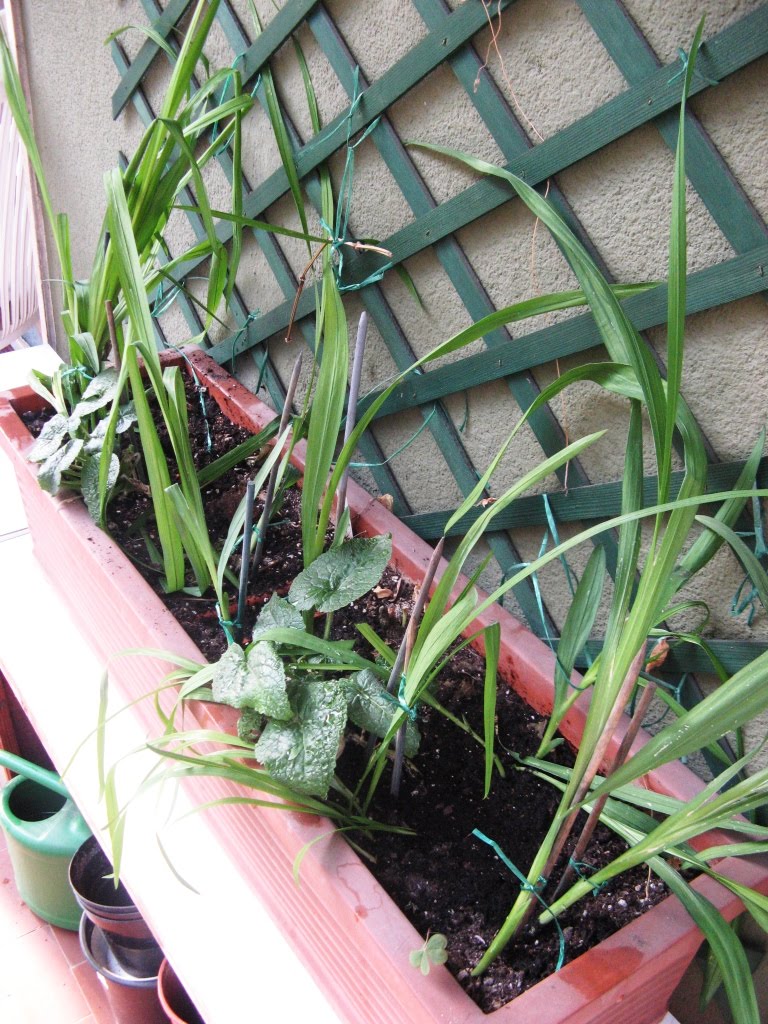
And yes - for those of you who were trying to guess the mystery seedling of a couple of posts ago, I'm now growing cotton on the balcony. And by pure chance, the other day I found out that Milan's climate is classified as the same as those of the cotton producing states of the US - humid subtropical. I'm only surprised that it's not grown here commercially.

It germinated almost instantly, is growing rapidly, and I'm keeping my fingers crossed that there's enough time for it to do something before the colder weather arrives. The flowers are supposed to arrive after 35-45 days. They only last a few days, but flowering will go on for a month. That should take us from the end of August - still hot and sunny - till the end of September - getting cooler . It takes another month for the cotton bolls to mature - but I suspect it will be too late. By mid-October they'll need to be inside, and the plants are 3-4ft tall - I'm not sure I have room for an entire plantation in the flat.


We'll see. I could certainly bring one in. But if it goes wrong I shall definitely try again next year, starting earlier. If you'd like to try too, keep in mind the following :

1. The seeds need a temperature of 16°C/60°F to germinate and then at least 21°C/70°F to grow successfully. Start them off in March/April, in the house or greenhouse as necessary, sowing 2/3 seeds per 9" pot. Thin out any weaklings as they come through. The soil should be moist at first, but afterwards keep them fairly dry.

2. As they start to grow, transfer each plant to a 30cm pot and start watering. Again they should be slightly moist but never waterlogged. Feed weekly with a high potash fertiliser - they need high nitrogen and potassium. A liquid tomato food will do fine. If they've been started inside, they'll need hardening off gradually before being left out, and like all tall plants will need to be staked.

3. The plants are prone to red spider mite, so mist them frequently as a preventative measure.

4. Stop watering about 16 weeks after planting and let the plants dry up and the bolls finish forming. Pick them when they split open, showing the fluffy cotton,and you'll have your seeds for next year - but be careful of the prickles. If the bolls are exposed to rain they may rot, so pick them immediately and let them dry and open indoors.


Acknowledgements

Many thanks to Old Shoe Woman for making the photos of the cotton flower and boll available under Creative Commons Licence on flickr.


Wednesday, July 15, 2009

(Almost) Wordless Wednesday : Bullrushes


The other week I went for a walk in a large country park on the edge of Milan ....


There was a pond surrounded by bullrushes.

GBBD : July Wilt


July wilt. You won't find it listed under pests and diseases in your gardening books, but it's one of the worst threats to the garden I know. July comes, the temperature rises over 35°C (95°C), the humidity soars, and the plants wilt. And so does the gardener.


The good times are over. May and June, when everything was green and bursting into bloom, seem far away. Some things resist - these little pelargoniums are doing well - this is the second time they've flowered, and so are several of the surfinias and petunias - though I've lost a lot of others.


But they're the exceptions. All over the balcony plants have succumbed to the heat, to pests or to fungus diseases, leaving tell-tale brown patches in the containers which have to be filled with tougher plants, that resist better. But who has the energy to get to the garden center and buy them? I take advantage of the cool half hour after a late afternoon storm to run out and pick up a few periwinkles - a Godsend at this time of the year. They come into bloom just as everything else is dying, love the heat, and never seem to be touched by any sort of pest or disease. Regularly in July I find myself saying - To hell with it. Next year, I'm just growing periwinkles.


And for the small gaps there are always baby spider plants to be detached from their "mothers" and tucked into the pots. Not desperately impressive maybe, but better than brown spaces.


Not everything hates the heat of course. The plumbago thrives in it. I had disappointing results with my plumbago last year because I'd moved it to a place where it didn't get enough sun, and hadn't bothered to prune. This spring I cut it right back and moved it back to the balcony railing, where it had always been happy before. And once again, it's been full of blooms - they've occasionally been spoilt by the thunderstorms, but there have been so many that within a couple of days it's bounced straight back.


There's not much else to show for this month's Garden Blogger's Bloom Day, but one container has surprised me.


My calendula have done well this year and are full of buds. They usually submit to mildew fairly early on, but this year have been fine. I miscalculated a bit with the arrangement - I thought the marigolds would be taller and the calendula shorter - perhaps I should have pinched them out. And don't ask me how that sunflower got in the back there. I've left him because at least he matches the colour scheme ...


I found out today that Milan is classed as having a humid subtropical climate - that's the same as the south-eastern states of the US - Alabama, Mississippi and so on. Which in one way is a lucky coincidence, because it means that my new balcony experiment might not be so crazy after all. I'm growing a plant which I've not seen in Italy before, but which would be right at home in Alabama. It germinated about a fortnight ago and is growing fast. Any guesses?


Wednesday, July 08, 2009

Water Lilies


Claude Monet is perhaps the best known of the impressionist painters. But he was also a gardener, and created one of the most beautiful gardens in Europe, at Giverny in Normandy. And for thirty five years the flowers from the Giverny garden were crucial to his art.

I did my first degree in Cardiff, still my favourite ever city. The Uni. is in the town centre, and just down the road is the National Museum of Wales, where I spent I don't know how many lunchtimes (admission was then, and is still now, free). Don't ask me what the museum contains in general - I can't remember. I always headed straight for the art section - either for the Pre-Raphaelite paintings or, much more frequently, to see the Monet water lily collection. Where I would sit, maybe just for ten minutes, and look.

Monet produced 250 paintings of water lilies, so it's not surprising that many important galleries have a collection. But obviously, France has a prior claim. The painting below is from Les Orangeries in Paris. They built two oval rooms specially because that is how Monet wanted the paintings to be exhibited.


But since leaving Cardiff, I don't think I've seen one of Monet's paintings - until this summer when an exhibition opened at the Palazzo Reale in Milan. An exhibition which was doubly attractive because it linked Monet's work to the work of various Japanese artists such as Hokusai and Hiroshige.


I have to say that, in comparison to what I'd seen in Wales, the Monet paintings in the Milan exhibition were a disappointment. There were two that I enjoyed, but some of the others left me cold. However, the exhibition was well worth a visit for other reasons.


It started at the entrance, where they had laid out a minature "garden" representing both the lake in the garden created by Monet at Giverny, where he painted the waterlilies, and the Japanese influence on his work. Then the building. Palazzo Reale is a 14th century building in the centre of Milan, now used for art exhibitions. But its sweeping staircases and high vaulted ceilings are as much worth a visit as the paintings it houses.


The Monet paintings, as I said were a disappointment. The paintings were small - part of Monet's appeal is the size of some of his work - and with the exception of two, didn't particularly attract me. But the interlacing of the Japanese prints and the information given on the influences on his work were fascinating, and the exhibition was well worth visiting just for that.


Katsushika Hokusai (1760-1849) : The Great Wave off Kanagawa


Monet never went to Japan, but collected Japanese prints assiduously and had a collection of 231 of them at Giverny. His own paintings often reflect the structure of the prints - notice for instance the similarity in the lines in this Hokusai painting of Mount Fuji and Monet's haystack series. But most of all they influenced him in their treatment of the natural world - the landscapes, rain, snow, trees and plants so often featured in the prints.


Utagawa Hiroshige (1797-1858) : Maple Trees at Mama ...


Because, although Monet's paintings include representations of people and towns (including some wonderful paintings of London and Venice), his paintings above all feature natural scenes - many from the Giverny garden.

In the final years of his life Monet said "Gardening was something I learnt to do in my youth, when I was unhappy. Perhaps I owe it to flowers that I became a painter."


Monet bought the house in 1890. The Giverny garden is divided into two areas : the flower garden near the house; and the water garden, where Monet painted his waterlilies and built a Japanese style bridge (though painted green rather than the traditional red of his beloved prints). A third area, a short distance away, was turned into a vegetable garden and orchard. For the first ten years Monet worked on and painted the flower garden, and then turned his attention to the boggy area behind it, across the railway line. To create the water garden he had to get permission from the local council to divert the course of a river - something initially strongly opposed by the local people who feared that the painter's "strange plants" would poison the water.

Monet worked on his water lily paintings up to 1925, a year before his death. He was 86.

Why did the impressionists paint as they did? I guessed long before I saw any official confirmation. It came to me one day in the early 70s as I was sitting on top of a 54 bus, crossing Blackheath in London. I am extremely myopic and slightly astigmatic, and for some reason which I don't now remember, that day I couldn't put my contact lenses in nor use my glasses. As I looked out of the window onto the heath, the world suddenly turned into an impressionist painting. At the time, I had no idea that the impressionists had sight problems, but yes - Cezanne and Renoir were myopic, Degas was gradually losing his sight as he painted, and both Monet and Mary Cassatt, the most famous female impressionist painter, suffered from cataracts which affected their perception of colour. And most tellingly for me, it is also said that Monet was astigmatic. It's said that he was once fitted for a pair of glasses to right his vision, but refused to wear them saying indignantly "If the world really looks like that I will paint no more!" I sympathise. I too am fond of my fuzzy sight. Not to the extent of refusing to wear lenses during the day - but oh how nice it is when I take them out at night and the world becomes a gentle, unfocused blur.


Now that I've seen the exhibition, Giverny has risen to the top of my wish list of gardens to visit. But when I go, I'm not putting my lenses in. I shall wear my glasses. And very,very often as I walk around, I shall take them off.


Acknowledgements

Thanks to the following photographers for making their work available under Creative Commons Licence on Flickr. All others are my own :

alex4981 : Water lilies in the Orangerie
peterjr1961 : Hiroshige print
freakland : Hokusai print
Greg_e : Giverny photos


Saturday, July 04, 2009

Go on - you know you do it too ...


The seven deadly sins of gardening. And I confess, I confess - I'm guilty of every single one. But go on - hand on heart can you really say you don't do any of them?

1. Thou shalt not pull the seed pods of the heads of newly sprouted seedlings. Oh, but they look so trapped. Surely they'll never get them off without help. Yes, I know that last time both the seed leaves came off with it. And the time before, and the time before that. But I was only trying to help. Surely, this time if I'm gentle ...


2. Thou shalt not dig up your bulbs and tubers to see if they're doing anything yet. But they've been in there so long and there's no sign of anything. I won't disturb them, promise. Yes, all right, I did rip the roots off that Jerusalem artichoke last time, but this time I'll go really, really carefully...

3. Thou shalt not forget to go back and empty the surplus water out of the saucers under the containers. Yes I admit it - there's no excuse for this one. I just got distracted. OK, OK - I just got distracted again. But it might be all right this time. I mean it's a big pot and it will only be the bottom couple of inches which are soggy. Maybe the roots haven't got down that far yet...


4. Thou shalt not forget to label your seed pots - not only with names, but above all with colours. Now, I resent that. You know that I labelled every single pot in the last batch. What do you mean, going back half an hour later and labelling things Mystery and ???? doesn't count? And as for colours - well, maybe I like that bright pink zinnia in the middle of the marigolds...


5. Thou shalt not throw in another couple of handfuls of fertiliser just to "finish off the box". What? The Four O'Clocks you mean? But look how healthy they are. Look at that foliage. Have you ever seen them come up so lush and green? They're a delight to see. Oh .. right -no, I suppose they're aren't many flowers this year ...


6. Thou shalt not try and grow plants which you know perfectly well won't survive in your garden.
You're not going to let me forget those hostas are you? Oh - it was the Himalayan geranium you were thinking of. Well, you never know - we might have had a cool summer that year...


7. Thou shalt not - but wait a moment, it can't just be me. Go on, you know you do it too. So confess. What's your seventh "deadly gardening sin" ?


Wednesday, July 01, 2009

Skywatch Friday : Reminds me of ...


I don't have any particular knowledge of art, but there is one period that I've always loved - the art of the Pre-Raphaelites and the Impressionists in the late 19th and early 20th centuries.

And the precursor of both styles was JMW Turner, perhaps the greatest sky painter ever. If Skywatch Friday is looking for a patron saint, he's surely a candidate. He painted both in water colours and in oils - one of my favourites is
this watercolour of Venice in the early morning, but have a look here for more of his work.

I got to know Turner's work when I was a student. I studied in Cardiff, but when I was home in London for the holidays would often go to the Tate Gallery, which has the largest Turner collection in the world. I hadn't thought about him much recently though - not that is until I downloaded this photo, taken from the back balcony one evening...


I almost felt I should be looking for Turner's signature.

Turner lived from 1775 to 1851. He started painting as a child, and after first working as assistant to an architect, started studying at the Royal Academy at the age of 14. He was fascinated by light, and many of his pictures are of the sea, showing the effects of light not only in the sky but also reflected off the water. There is a story that he once had himself strapped to the mast of a ship in order to observe a storm, saying later : "I got the sailors to lash me to the mast to observe it; I was lashed for four hours, and I did not expect to escape, but I felt bound to record it, if I did."

Turner's behaviour was a bit weird in general. He was a solitary, antisocial man with few friends, described by the French painter Eugene Delacroix as "Silent, even taciturn, morose at times, close in money matters, shrewd, tasteless, and slovenly in dress". Ah well, you can't have everything.

So there you are. My offering for this week's Skywatch Friday is a homage to Turner. Lots of other people have already posted their photos, and of those up so far, my favourite are these from the 7MNS Ranch in New Mexico. Turner would have loved them.

Hibiscus


I spent much of last weekend tidying up the balcony and sowing biennials for next year. And as I was rooting around in my seed box, I found these. They were just laying on the bottom of the box and had obviously fallen out of a packet. But what were they? They were the cutest seeds ever - heart shaped and feathery - but I couldn't remember ever having seen them before.


And then I came across an envelope marked hibiscus. There are a number of hibiscus in the gardens around the balcony, and I remembered that last year I'd broken off a couple of seed pods to save. And then forgotten about them. But over the winter the pod had dried and burst, and as I was scrabbling around for other things the seeds had fallen out.


When I think of hibiscus, the first thing that usually comes to mind is a houseplant. But Hibiscus is a genus with over 200 members, but I'm fairly sure that the ones growing here are a species native to eastern Asia called Hibiscus syriacus. It's hardy and I also have one in my London garden. Here, there are over a dozen of them lining the alleyway that leads between the blocks. They've been planted in the middle of a privet hedge and several have been trained into a standard shape, so that the trunk is covered by the hedge and the bush just seems to be a round ball sitting on top of it. Others just poke through. They're just coming into bloom now, but very shortly the alley is going to look glorious. The blooms only last a few days, but there are so many of them that the bush always seems covered.


Walking past in the last couple of days, I've also been pleased to see that there have been a couple of bees buzzing around them. Bees have been scarce this year, and I'm not sure whether it's because I've neglected the balcony and have had fewer blooms than usual to attract them, or whether they're just not there. Look at the first photo and you can see one. He was literally drenched in pollen.


Anyway, the seeds are now in, just for fun, but I've taken some cuttings too, which are keeping my oleander and pelargonium cuttings company. Hibiscus is supposed to root readily - we shall see.


The flowers of H. syriacus are small in comparison to the tropical varieties, but they still blow me away. Definitely a plant to find a space for. And very undemanding. It likes sun and doesn't like to be too wet, but apart from that isn't particularly fussy. I have to admit to having a soft spot for a lot of plants in the Malvaceae family - I also have mallow and hollyhocks growing on the balcony and love them both. Here's hoping the cuttings take.