Saturday, June 23, 2007

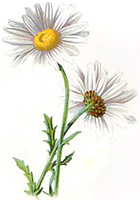
Yarrow - Achillea Millefolium

This month’s plant on the calendar is Achillea Millefolium – yarrow. I have to say that I only knew yarrow by its common name and I’d never linked it with the Achillea that I see in my garden centre every spring – which if I remember correctly is Achillea Lavatera, but I’m not sure. It’s not a plant which has ever particularly attracted me – the flowers were OK but the stems always seemed thick and gawky. And of course it's yarrow stalks which are used in the I Ching - the Chinese form of divination. The Chinese considered it to be a spiritual plant, and would plant it on the graves of their ancestors.

According to the calendar, yarrow can be turned into a tea to be used against period pain, while on the web Purple Sage lists a range of uses including action against fever, high blood pressure and diarrhoea. Purple Sage also mentions the origin of the name – it was apparently named after Achilles, who frequently used it to heal wounds after battles, and in fact one of its many common names is Soldier’s Woundwort. One of the reasons its now so common in Europe is apparently that wherever the Romans went, they planted it around their camps so as always to have a ready supply. And then for the same reason the British army took it to North America when they colonised.

Back to the literary references. I went and found my copy of The Iliad (probably for the first time in thirty years!) and found the passage. A wounded Greek lord asks Patroklos to use some herbs which Achilles has told him of to heal his wound :

… Patroklos laid him there and with a knife cut the sharp tearing arrow out of his thigh and washed the black blood running from it with warm water, and, pounding it up with his hands, laid on a bitter root to make pain disappear, one which stayed all kinds of pain. And the wound dried and the flow of blood stopped. (The Iliad, Trans. Richmond Lattimore Book 11 lines 843-847 Uni. of Chicago Press)

It also pops up in Longfellow’s Hiawatha (section 15). Hiawatha has a sort of breakdown after the death of his friend, but is sorted out by the medicine men in a healing ceremony :

There a magic drink they gave him,
Made of Nahma-wusk, the spearmint,
And Wabeno-wusk, the yarrow,
Roots of power, and herbs of healing;
Beat their drums, and shook their rattles;
Chanted singly and in chorus,
Mystic songs like these, they chanted.

And upstarting wild and haggard,
Like a man from dreams awakened,
He was healed of all his madness.

This links to another use, common in Scotland, of using yarrow tea as a remedy for depression – a sort of countryman’s Prozac.

Yarrow can cause an allergic reaction, though this is said to be rare, and is not advised for epileptics.

Saturday, June 16, 2007

Gardener's Bloom Day - June


Gardener's Bloom Day again - I'm a day late but I took the photos yesterday so I hope it counts. Not much to report this month. I have to admit that I planted almost exclusively for spring this year. I'd thought that I'd be spending the whole summer away from Milan, and so there was no point focusing on the later months. But plans changed, and I'm still here. Plus the devastation that's been wreaked by caterpillars this year - it's left me a bit flowerless. So you'll notice a decided lack of wide angled shots in the pictures. I admit to having chosen the best bits.


The best thing at the moment is the plumbago (top picture), which is an execption to what I've just said. As are the ivy-leaved pelargoniums. A second group of nasturtiums are now out, and the surfinia and antirhinums are hanging on well - boosted by the marigolds which are just starting to flower.


But the surfinia and marigolds are nothing like the ones I had last year. The surfinia (bought) are a different variety - I couldn't get the same ones as last summer - with smaller leaves and flowers. But they're also growing far less enthusiastically and look weak and spindly. The marigolds are suffering too, and lots haven't made it.


Odd, when I've treated them exactly the same as before and last year got such great results. The same is true for some of the other stuff I've sown this year, especially the zinnias and hollyhocks which were my pride and joy in 2006 and this year look considerably stunted. as far as the zinnias are concerned, I wonder if it's because I tried growing them in eggshells? It's not worked well for anything, which with some things I put down to too much calcium in the shells. But zinnias are calcium lovers, so I was hoping they'd do well. Oh well, chalk one up for experience.


And then there are these rather weedy sunflowers, which is what you get if you steal seeds out of the hamster's food box rather than going and buying some decent ones. They're pretty but a bit straggly.


The seedlings which are doing well this year are the white and purple surfinia which I sowed with last year's seeds. They're not flowering yet, but look healthy and happy. With the plumbago and the ivy-leaved pelargoniums, they're more or less the only thing that does at the moment. Watch this space next month!

Saturday, June 09, 2007

Luxury Flat to Let (One Room to Share) with Built-In Restaurant

I have posted before on the plague of caterpillars which are devouring almost every plant I've got this year. I'm having to pick them off daily and am still not winning. But as I'm not into killing things, they all go into the caterpillarium.

The caterpillarium started when my son was small and I wanted him to see how caterpillars turned into butterflies. It's an old toy box partly filled with soil into which go various "extra" seedlings which I'd otherwise have thrown away, plus any plant which is too far gone to save - this year there have been a lot of the latter. In go the caterpillars, which then chomp away, pupate, hatch - and lay their eggs on my plants once more. So we start all over again.

I had to redo the whole thing today as everything had been eaten by previous generations. On the menu we have : spider plant, antirrhinums, alyssum, hollyhock and various other bits and pieces. Needless to say, I make sure to put in the plants that they seem to attack most in order to encourage them to stay put. Now if only I could find a way of directing the butterflies straight there ...

Wednesday, June 06, 2007

Not So Loony Gardening ?

Do you garden by the moon? I get a monthly gardening magazine which gives a guide to the phases of the moon and advises on what should be done in the garden at each stage - from sowing to pruning. But I have to admit that I rarely follow it. My gardening schedule tends to depend much more on what I've got time for each week than what I think really ought to be done. Occasionally I do follow the guide, but always forget to label the plants so that I can compare them with others which were sown (or whatever) at the "wrong" time, so that I can see if it makes any difference.

But I was interested to see an article on the BBC site from back in May explaining how 600 volunteers were going to be working on a National Trust site planting annuals in sync with the moon and also explaining why it's supposed to make a difference. The article explains :


The Biodynamic Sowing and Planting Calendar predicts how plant sap and water table levels will be impacted on by the moon's gravity, and identifies optimum times for sowing certain types of plants.
According to the calendar, the moon's gravity produces varying conditions for planting, and is much more specific about the exact time when a flower, root or plant should be placed in the soil than conventional planting schedules.


Too late now for my summer planting, as everything's in. But perhaps it's a project for the autumn. Watch this space ...


Acknowledgement
Thanks to gonzalo_ar for making the photo of the moon available under Creative Commons Licence via the flickr site

Tuesday, June 05, 2007

The Revenge of the Loquat

Never insult a plant - they have their own ways of getting back at you. A couple of weeks ago I made some very disparaging remarks about the fruit of the Japanese medlar (or loquat) tree. But only a couple of days later our caretaker picked the fruit of the tree in the garden of our apartment block and gave me several kilos. And they were delicious. He must have picked them at just the right moment, as they were soft and sweet but not at all gungy. The rest of my family declined anyway, but (with some sturdy help from the hamster) I gorged for about a week. And then started to itch ... and scratch ... and swell up. And it turns out I'm allergic to the things.


As always with these things, it flared up really badly on Friday, just after the doctor's surgery had closed for the weekend. So I had a thoroughly miserable weekend. It's easing up now, but if you happen to be in Milan and come across a madwoman with ears like Dumbo violently scratching her scalp, you'll know who you're looking at. I'm sorry, tree, I'm sorry ...

Friday, June 01, 2007

Invasion of the toxic caterpillars

I've mentioned before that I've been having problems with caterpillars this year, and it's been getting worse and worse. We always have some, but nothing like this year. I've been going out every day to pick them off, and I've still lost about a third of my plants. For the first time ever red spider mite has paled into insignificance in comparison.

So I was interested today to come across a videoed news report on the BBC site about an invasion of toxic caterpillars in Belgium. It's such a plague that they're having to mobilise the army to deal with them. I can't link directly to the video, but click here and it will take you to the right page to find it (see the right hand sidebar).

Sunday, May 27, 2007

Calendar Calendula

The flower on my calendar this month is calendula officinalis. It’s a plant I’ve never had much luck with – it germinates without problems, but however much I pinch out the growing tips, it seems to end up looking gawky, straggly and out of place in the container. My local garden centre manages to get them to be low-growing, bushy and compact, but I’ve never quite worked out how. Different varieties maybe, though otherwise they look the same. And then it seems to be very prone to attacks by powdery mildew – ironic as one of its uses is supposed to be as an anti-fungal agent.

According to the calendar it has been used medicinally since the time of the ancient Egyptians. It has anti-bacterial and anti-inflammatory properties and can be used externally against a variety of skin complaints – acne, eczema, boils and abscesses, minor burns and other wounds, nappy rash and chapped hands or lips – and also against haemorrhoids, strains, bruises, varicose veins and what I think might be housemaid’s knee. But don’t quote me on that one as I’m making a wild guess at the translation.

The useful part of the plant are the flowerheads, which are gathered from June to September – best according to the calendar between 11 and 12 o’clock – and dried before use. They can be prepared in various ways, of which the two simplest are :
  • As a tea. Steep 1-2 teaspoonfuls of the dried petals in 150 ml of boiling water for 7 minutes, then strain. Apart from medicinal uses, this can also be used as a rinse to lighten hair and give it a golden tint.
  • Or you can soak nine flowerheads in milk for half an hour. You then strain off the liquid and use a cotton wool pad to dab it on to acne.

The best English account I’ve found on the web is at Plants for a Future, though as ever Purple Sage is also very good. These two also list other medicinal uses – against stomach ulcers, bad circulation and various other ailments. They also mention its use in cooking – the leaves can be used in salads, and the petals used as an alternative to saffron to colour soups, rice etc.


Thursday, May 17, 2007

On Medlars and Shakespeare


At the end of last October I posted about the medlar tree outside the balcony which was then in flower and full of swarms of bees - so the bees were certainly around before the winter, despite what I said in the post On Bees the other day. Anyway, the tree is now full of ripe fruit, much to the delight of the local birds who are doing their best to get to it before we do.

I've realised that the name medlar may have been misleading. It's actually a Japanese medlar, or loquat (Eriobotrya japonica), which is a different genus from what is normally meant by medlar (Mespilus) though both are from the same subfamily maloideae - which also includes fruits like apples and pears.

Loquats (nespole in Italian) are quite popular here - lots of people grow them and you can buy them in greengrocers and supermarkets. I've never seen them in Britain and maybe the climate's not suitable for the tree. But even the other type of medlar seems to have gone out of fashion in the UK. Till I came here I had only ever heard of it through Shakespeare's plays. I don't actually like the loquat fruit much, and it seems that Shakespeare didn't like the type of medlar he was familiar with either, as all the references are derogatory. His description of the fruit in As You Like It is just as true of the loquat as of other medlars - Touchstone has been reading some dreadful poetry written for Rosalind by Orlando and says ...

Touchstone : This is the very false gallop of verses: why do you infect yourself with them?
Rosalind : Peace! you dull fool: I found them on a tree.
Touchstone : Truly, the tree yields bad fruit.
Rosalind : I’ll graff it with you, and then I shall graff it with a medlar: then it will be the earliest fruit i’ the country; for you’ll be rotten ere you be half ripe, and that’s the right virtue of the medlar.


When they're not ripe, loquats are very sharp - but they then turn brown and rotten very quickly. So you tend to bite into them and find acid on one side and gunge on the other.

But the tree is beautiful, with broad glossy leaves which are light green when they're young and turn dark green as they get older. Ours is right outside the kitchen and I often stand on the balcony with a glass of wine in the evening while dinner is cooking, just looking at it.

Wednesday, May 16, 2007

Cacyreus marshalli ... and company

May is the month the pests come back, and I've already had my first run-in with red spider mite. I think I won, but it's only the first battle in a war which will go on till the autumn, so I'm now checking daily and spraying regularly as a preventative measure with a mixture of onion, garlic, cloves and cayenne pepper which I found on a site called Bonsai Garden.

Other pests are also rampant and my caterpillarium now has a large number of residents chomping away. Unfortunately, I haven't always been able to move them in on time. I was in Tuscany for a couple of days last week and came back to find one of my chrysanthemums in an extremely sorry state - half eaten by voracious green caterpillars, and the other half infested by blackfly.

But the most worrying thing this year is the enormous number of geranium bronze butterfly (cacyreus marshalli) caterpillars that I've found. This is a pest that is rare so far in the UK and one that you're supposed to report officially if you see it - you can see photos and get details on the site for the Department for Environment, Food and Rural Affairs. But it transferred to southern Europe from Africa some years back, and in Italy is now well established. Not surprising, as it can go through 5 or 6 generations a year. It attacks pelargoniums, and though the mature caterpillars feed on the leaves and flowers and so are easy to spot and pick off, by then the damage has been done. There's an earlier stage where the newly hatched larvae bury into the stems and tunnel down through the plant, and that's what really does the damage. So there's no way of confining this one to the caterpillarium.

Acknowledgement :
Photo of the geranium bronze butterfly provided under Creative Commons Licence by zigari44 via flickr


Tuesday, May 15, 2007

What's blooming on the balcony?

It's Gardener's Bloom Day again, so here's what's blooming on the balcony this month.

Nasturtiums ...
Surfinia ....


Surfinia, antirrhinums, nasturtiums, pelargoniums .... and my neighbour's bouganvillea.


The bougainvillea is beautiful, but is a horrible colour clash with the salmon pink of the geraniums. When it first arrived I hoped against hope it was there only temporarily and would soon be moved further away. But no. I think I'm going to have to be the one who gives in and moves the containers around.


All in all it's very quiet this month, after the explosion of blooms in April. The stock and wallflowers are now well over, though they're still there as I'm waiting for the seed to ripen before I take them out, and the seeds that I planted in March/April are now at the bolshy adolescent phase - big enough to take up a lot of space but not yet ready to do anything useful. Coming on well are sunflowers, busy Lizzie, surfinias, marigolds, campanula, mirabilis jalapa and lobelia.


The real bloomers over the last few weeks have been the pelargoniums - red, white and salmon - the begonias - red and yellow - and the antirrhinums, which have been terribly well-behaved this year. With only two exceptions, the yellow ones came up yellow, the pink ones came up pink, and the white ones came up white. A bit boring really.
Related Posts with Thumbnails