Sunday, October 28, 2007

A Daisy Chain


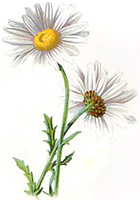
The flower which I found on the October page of my calendar came as a surprise - bellis perennis, or the common daisy. It's not a plant I would really associate with autumn, and even the calendar admits that April to August is the best time for collecting the leaves and flowers of the plant for medicinal uses. I suppose calendar compilers are a bit like bloggers - there ar some months when you just can't find anything current to write about ...

Daisies have been used medicinally since the ancient Assyrians, who used it to combat eye problems. It's most common use, in ointment form, has probably been to treat wounds and bruises - hence its common name Bruisewort. Other uses over the ages have included to cure ulcers, arthritis, rheumatism and liver complaints.

The calendar suggests using it for coughs, dry skin and eczema. For coughs make a tea by adding 250ml hot water one to two teaspoonfuls of leaves and flowers, leave it to stand for 10 minutes and then strain. You should drink it three times a day. For dry skin or eczema you can add it to your bath water. Mix up equal quantities of dried pansies (flowers and leaves, daisies (flowers and leaves) and calendula flowers. Steep 30 grams of the mixture in two litres of boiling water for 20 minutes. You then drain it and add the liquid to your bathwater.

There's a lot on the web about daisies - growing them, their medicinal uses throughout history, legends and sayings. They come up a lot in literature too. So here's my "daisy chain" of links....


Four sites discussing the cultivation of daisies; medicinal and other uses throughout history; sayings, legends and symbolism regarding daisies :

Plants for a future

My Garden

Flower and Garden Tips

PaperTheTown


Daisies in literature

Chaucer on daisies (scroll down)

Shakespeare on daisies

Wordsworth on daisies

Tennyson on daisies

Sunday, October 14, 2007

Gardener's Bloom Day


Tomorrow is GBD, but I know I'm going to be too busy to post. So here goes, five hours early.


My pride and joy this month are my asters. I've had this plant for about three years, but every September it gets hit by white mould, and I end up having to cut it back before it blooms. This year I sprayed preventively and it's given me the best display so far.


Also beautiful are these chrysanths, but I'm less proud of them as they were bought recently. My own seemed to have succumbed to something - the top leaves are still fine, but the majority have browned and died. A watering problem? A fungus? I'm not sure. They have a lot of buds, but the plants as a whole look tatty.


That's the autumn stuff, but we've had a really warm October this year - we were out in T-shirts today and it must have been around 80° at mid-day. So a lot of the summer annuals are still blooming happily. In particular, my white surfinia were really coming on - but as they trail over the balcony, they were badly damaged by a couple of days of monsonic rain which we had about ten days ago. The plumbago was also hit, but it's bounced back.


Everything else though is doing fine, with a lot of things blooming again for the second time. These little antirrhinums, unlike most of their friends, have escaped the caterpillar plague, as has the white alyssum. The purple alyssum was too badly hit to warrant a photo here, though.


The four o'clocks are still blooming, though I'm starting to collect the seeds as well. And I've put in some cyclamen and some pansies for the winter and spring. But I'll save them for future posts.

PS : I've now got a lot of links for the Garden Bloggers' Retro Carnival, and thank you to everyone who's sent them. There's still time if you haven't sent in a link yet. The carnival starts the first week of November.

Sunday, October 07, 2007

Hooked on Succulents ...

First of all, thank you to everyone who has sent links for the Garden Bloggers' Retro Carnival. People have sent in some really nice posts, including some with stupendous photos. But don't worry if you're still thinking about it - there's time yet. Just leave me a comment with the link to the post you want to nominate.


The BBC seems to be hooked on succulents at the moment. Every time I go into their Science and nature news site there seems to be an article on some cactus bursting into flower. A couple of days ago I found
this feature about a Hoodia plant, which has flowered for the first time ever at the Eden Project. It's native to South Africa and has always been eaten by bushmen in the Kalahari desert to ward off hunger. Research is currently being done to see if it can be used to fight obesity - hopefully it's not the flowers which they need to use.

But at least at the Eden Project they don't have
the problem caused by an Agave Americana at the University of Wales in Bangor. If you have one yourself, don't plant it in your greenhouse ...

A friend of mine gave me the mother plant of the succulents in the picture (I've forgotten their name). These are cuttings I took a year or so ago. They've grown at a rate of knots, but they haven't flowered yet. Should I be worried?

Monday, October 01, 2007

Let's Have a Garden Bloggers Carnival!


About a month ago, in connection with my other blog, I received an invitation to participate in a "blog carnival". The idea is that bloggers who are writing on the same topic send a link to one of their posts to the carnival organiser, who then publishes them with a brief description of what the post contains.


I thought it was a great idea, and wondered if we could do the same for garden blogs. But given we've got Garden Voices which does the same thing every day (thank you GV!), there didn't seem much point.


Then about a week ago, I was looking for an old photo which I remembered posting last year, and came across a post which I'd completely forgotten writing but which, on rereading, seemed really good. And it occurred to me that we all must have posts sitting in our archives which deserve another outing.


So here's the idea - send me a link to a post you wrote some time ago, which by now everyone will have forgotten about, but which you think is worth re-reading - or which you'd like new readers to see. Use the comments box - I won't publish the messages but will collect up the links. Then, during November when life in the garden calms down (at least for those of us in the northern hemisphere), I'll publish a series of posts including all of them. We'll call it the Garden Bloggers' Retro Carnival. Just to get you in the mood, the photos on today's post are all from 2006 to early 2007 - spring, summer, autumn and winter.


Anyone's welcome to participate, so by all means pass the message on to other bloggers you're in contact with. And if you haven't been blogging long and don't have any old posts, don't worry. Send a link to a recent post and we'll have a newbies section.

If you'd like to see what a blog carnival looks like, have a look at this one which focuses on books and reading .

Sunday, September 30, 2007

Hollyhocks


The last day of the month and the last chance to write about this month's featured flower on my calendar - hollyhocks.

Hollyhocks are one of my favourite flowers and, after last year's success, I planted loads last autumn. But it was obviously too late for them to flower this year, and they've settled for being triennial rather than biennial. They all got to about two foot in height and then stopped, though they've gone on putting out new leaves. Despite the caterpillar damage, they should be fine for next year.


Before I saw the calendar, I'd not realised that hollyhocks had medicinal uses, but apparently the flowers are good against things like sore throats, laryngitis, bronchitis and so on. You make a tea by steeping the petals in cold water for two hours, draining the liquid off and then either drinking it in small sips, or gargling with it - within five hours, so that it's fresh. The liquid can also be used externally for skin problems.

Browsing various articles on the web for more information on hollyhocks, I came across the book A Contemplation Upon Flowers: Garden Plants in Myth and Literature on Google books. It tells of a legend concerning a fairy island that would appear every Midsummer's Day at the point where the Wye and Severn rivers join on the border of Wales and England. Mortals were allowed to reach the island by means of a tunnel under the river and, though they never saw the fairies, would be treated to a day of music and feasting. The only condition was that nothing should ever be taken from the island, which the humans respected until one year a young girl wanted to take back a bunch of flowers which she had picked there. Her mother stopped her, but in secret the girl slipped one of the flowers into her pocket. As the people returned home through the tunnel, the girl turned into a hollyhock, her pink pinafore becoming the pink flowers of the plant. And never again did the island appear.

Saturday, September 29, 2007

They're Back!


Two extremely busy weeks at work have meant no blog posts and a very neglected balcony. I'd rushed out a few times after dark to water, but apart from that hadn't really looked at anything in daylight for a fortnight. And so hadn't realised that the caterpillars were back ...


I've said before that they were bad this year, but I'd hoped that the worst was over. yet in the past couple of weeks they seem to have come back with a vengeance. Half my plants look like lace doilies, several have been completely stripped of leaves, and this poor hollyhock has just given up the fight.


Even worse though is the mess - both balconies were completely covered in caterpillar droppings. If you have a garden, you probably don't realise how much a couple of teensie caterpillars excrete, but on a balcony they just plop onto the floor and stay there. Here's hoping that next year they won't be quite so bad .


Saturday, September 15, 2007

September Blooms

It's Gardener's Bloom Day again (it seems to come around awfully quickly). So here's what's blooming on the balcony this month ....


Surfinia. I'm proud of these because they're the ones I grew from seed this spring. It took them a while to get going, but now there's a profusion of blooms. We're having a very hot September - although the mornings can be chilly, it's still up in the eighties by the afternoon. So I hope they'll go on for a while. Only the white ones made it, although the seeds were mixed white and purple.


Mirabilis Jalapa - the Four O'Clock Plant, Beauty of the Night, or whatever it's called round your way. Like the surfinia, these came from seeds saved from last year's plants. They've bloomed much later this year than last, and I haven't got the same profusion of blooms that I had before. But I'm enjoying them.


Pelargoniums - red, salmon and white. My salmon pelargonium has now bloomed continuously for eighteen months. Will it take this winter off, I wonder?


Periwinkle. Useful on the balcony because they don't get ravaged by pests and diseases, and are good for filling gaps in containers if other stuff dies off. And talking of pests ...


The Antirrhinums seem to have got their second wind and are blooming again. But so have the caterpillars. I didn't actually notice we had visitors until I printed out the photo.


Campanula - OK, this one's a cheat. I saw it in our local supermarket last Saturday and couldn't resist - it's the same variety as the one blooming in my London garden. Call it nostalgia.

Wednesday, September 12, 2007

Slugs, Snails and Sex


What's the difference between a balcony garden and a garden garden? The number of pests and diseases you notice. They're probably all there in the garden, but with such a large number of plants, the majority are liable to survive. In the London garden this year I only really had three problems.

The first was predictable - blackspot on the roses. I spray every time I'm there, but it's never enough. The second was a surprise - one of the cotoneasters half dead from red spider mite or something. But it was a big plant and after I'd cut back the three quarters that was badly affected, hosed it down and then sprayed, it bounced back with no problems.

The third was something you don't get on a balcony - slugs and snails. I've always liked snails and when I was a small child, used to keep them as pets in a cage. (I was horrified one day to find them all joined together in pairs. Having failed to pull them apart, I rushed screaming into the house to tell my mother, who reassured me that they were "just playing". And lo and behold, the next day they were all back to normal). I can often find two or three hundred or more in the garden over a two or three week period. Most of the time they're welcome, as they do the work of keeping down the weeds that the tenants usually don't, but once I've finished clearing the garden, and start to plant out seedlings, they become a nuisance. So I do a snail hunt, stick them all in a bucket and transfer them to the wildest part of the park behind the house - which is also the most remote from any other gardens.

Slugs though have always been a different matter. There was something about them that turned my stomach and I could hardly bear to pick them up, even with gardening gloves, to put them in the bucket. Imagine then the horror when I didn't realise that one had fallen into one of my gloves - until I started poking around in the fingers to find out what the squishy thing was.


This year though, there were so many in the garden - a lot more than usual and much bigger than usual, that I started to get interested. And by the end of the holiday was a convert. I'd not realised before how beautiful they can be.

So when I got home to my books and the internet, I started to do some research. It's difficult to be sure at a distance and I wish I'd taken more photos, but I think most of the ones in my garden were, like the one in the photo, the orange variety of the large black slug.

I also saw some Leopard slugs though - and if you really need convincing that slugs can be beautiful, have a look at this video of leopard slugs mating from the BBC. The Karma Sutra pales by comparison.


Saturday, September 08, 2007

Birds in the Garden


What are the most common birds in a South London garden? If you'd asked me thirty years ago, the answer would have been sparrows. Closely followed by starlings and pigeons, with a good smattering of blue tits and great tits and the odd chaffinch. There were also crows and thrushes around, and of the territorial birds, our garden always had its resident blackbird and robin families.

When the decision was made to turn the park behind the house into a wildlife reserve, the types of birds we saw started to increase. Greenfinches became common, as did magpies, and we'd also quite frequently see woodpeckers, nuthatches and various other birds.

When I went back this year, I was shocked to see how things had changed. Not only had the types of birds changed, the overall number was far lower. In particular, all the time I was there, whether in the garden or the park, I didn't see a single sparrow.

This surprised me so much I checked it out on the web, and yes - the sparrow population of London has dropped by ten million overall in Britain, with the population being reduced by 70% in London. That's an amazing number of birds to disappear. But why? The articles I found (look
here and here) seem to blame it on the fact that increased urbanisation and the use of pesticides mean less available food. But in our area, that doesn't seem to make sense - nothing has really changed. And London is certainly much greener than Milan, and here they're all over the place.

Of the others,the only ones which seemed to be thriving were the crows and the magpies. Others that still seemed to be around were the tits, the pigeons, the robins, and to a lesser extent, the starlings. But in reduced numbers, despite the fact that we put food out for them.

I did, however, see one bird which I'd never seen before, while I was walking through the park. A kestrel! Not something that I'd ever have expected to see in the city. If birds of prey are moving in, it might, of course, help explain the drop in numbers of the smaller birds. But surely not to the extent suggested in the articles.

We also have a new contender for the most common bird in the garden - and it's one no-one would have guessed at ten years ago :
the rose-ringed parakeet.

They've been becoming more and more common in various areas of Britain since about 2001, and in our areas are now the uncontended champions of the bird population. They fly in great flocks of ten or more birds, and land to feed on the garden fruit trees, screeching like crazy. No-one knows where they originally came from - though there are several urban legends : that the original pair escaped from a cargo ship which sank near London, that they were set free by Jimi Hendrix ... and so on. They have no natural enemies in the area, and breed exponentially. They live up to 35 years, and produce two chicks a year.There are now estimated to be thirty thousand in London, expected to rise to 50,000 by 2010.


I love watching them in the garden, though my attempts to photograph them were, as you can see, fairly pathetic. But they're not universally loved, mainly because of the incredible noise they make, and the fact that they go for the fruit trees. They may also be the reason why I didn't see any woodpeckers or nuthatches who, like the rose-ringed parakeet, nest in holes in trees and would therefore be in competition with them for nesting spaces. from what I heard every night though, the owls are still holding their own. So the RSPCB is considering a cull.

They say it's a last resort, and I hope it won't be necessary. But even if they do reduce the numbers for a while, I suspect the rose-ringed parakeet is here to stay.

Thursday, September 06, 2007

Wildlife in the Garden


I came across two mysteries in my London garden. This was the first...

How did my garden get to be full of egg shells?


OK. I have to admit that I partially know the answer to this one. Foxes. My garden backs on to a park which has a children's zoo containing a lot of animals - rabbits, goats, sheep, pigs, deer, ponies and so on - and also poultry of various sorts : chickens, ducks, guinea fowl and peacocks. It's also a wildlife reserve - and full of foxes. The foxes steal the eggs and bring them into my garden to eat. I frequently dig up old bones, or find the remains of dead pigeons lying around, too. The mystery is not so much who brings the eggs in, but how do the get them in the first place? Since a memorable chicken massacre which occurred many years ago, the enclosures have been made fox-proof. The fact that there are still chickens and so on around shows that they can't get in. So how do they get to the eggs? But year after year, wherever there's an overgrown patch of garden, I'll find white chicken egg shells.

We hear the foxes in the garden almost every night, and I used to spend a lot of time watching for them. But this year, it wasn't necessary to stay up - we frequently saw them in broad daylight. I think they were used to the garden being unused and abandoned. A big dog fox which I found doing something unmentionable in my newly-dug side bed was very startled when he saw me - and obviously couldn't quite decide whether to run for it immediately or finish what he was doing first. Of course, I didn't have my camera with me ...

The other mystery was - whatever were these odd-shaped tuber things? I must have dug up over a hundred of them, and couldn't work out what they were. Then after a couple of weeks I found this ...


and realised they were there for the same reason I had an oak tree growing in my rose bed ....

Squirrels. Burying their peanuts and acorns in my garden and then forgetting all about them. That does however leave another mystery? Why isn't my garden as full of peanut plants as it is of young oak trees?


Related Posts with Thumbnails