Sunday, July 18, 2010

Bees


I said in my last post that there didn't seem to be many butterflies around this year, either here in Milan or in my garden in London. Well, for bees Milan is just the same - I've not seen any this year. The hard winter again, or more problems of colony collapse disorder?

But when I was in London I was pleased to see that they were absolutely everywhere - and snapped away like crazy taking photos.

There were some honeybees (at least I think that's what this one is)...


But the vast majority were bumblebees. Which made me realise that I didn't really know very much about bees at all. How many types were there? What were the differences ? I knew that honeybees lived in colonies but that there were also solitary bees. What was the difference? How did you recognise them? And where do the bumblebees fit in? Were they social or solitary? And was CCD affecting all types of bees or just the honeybees?


So I did some research - and found some excellent websites, which are listed below. I'm not going to regurgitate it all, but I was surprised to find out that in the UK alone there are some 300 different species of bee - about 270 of which are solitary.

Solitary bees make a nest by burrowing into soil, soft brick or whatever. The female then gathers pollen and nectar, forms it into a patty, pops it into the far end of the burrow, lays a single egg on top and then seals that section of the burrow up before doing the same in the next bit - and so on up to the end. The very last egg is always male (bees have this strange ability to decide the sex of their children). The eggs hatch, and the larvae consume the food left for them and then pupate. The pupae all hatch at the same moment but the male, being closest to the exit, is the first to burrow his way out. He then waits for his sisters, mates with them, and the whle thing starts all over again. All a bit incestuous, but there you are.

So how do you identify a solitary bee? Well, by Googling them, obviously. I think this may be one ...


... and possibly this one too. Or is it just some sort of fly desperately trying to pretend he's terribly fierce?


Bombus bumblebees, on the other hand, are social and live in colonies. Unlike the honeybees, however, they don't store large quantities of food and all but the young already fertilised queens will die off in the winter. The queens hibernate and then in the spring secrete beeswax to form little cups which they fill with nectar and pollen, laying an egg in each one. As the new workers reach maturity, they start to collect food for the later-hatched larvae. But having only one season in which to form, the colonies remain quite small - whilst a honeybee colony may contain up to 70,000 individuals, bumblebee colonies rarely exceed about 300 and are often smaller.


But what I didn't realise was that there are nine species of Bombus bumblebee in the UK, some very common others quite rare. What were mine? To me, they all looked quite different. This one seemed to fit the description of the most common British type - the Buff-tailed Bumble bee. But the others? The colouring and stripes didn't sem to match. So I sent a few photos off to the Bumblebee Conservation trust (see below) for identification. Would I find that my garden was a home to rare bees?

Nah... the answer came back after a couple of days. All common as muck Buff Tailers.


Except for one. So far there has been no answer for the little one below who I found happily feeding off my borage. Could the delay be because I've discovered something rare? Doubt it. More likely that you just can't see enough from the photo to tell. My own suspicion is that this is not a Bombus bumblebee but a Psithyrus or cuckoo bumblebee - there are six species but don't ask me which this is. These are sneaky. They lay their eggs in the nests of the Bombus bumblebees and let them do all the work. You can tell the difference between the Bombus and Psithyrus bumblebees by looking at their legs. The cuckoos don't need to store food for their larvae and so don't have pollen sacs on their legs - sacs which you can see clearly in the photos of some of the Buff Tailers in the other photos, but which don't seem to be present here.


Will I be right? We'll see. If I get an answer I'll add it in the comment box below. But in case they don't get back to me - any bumblebee experts out there?

Read some more


Bumblebee Conservation Trust Bumblebee Identification
Natural History Museum Bumblebee Identification Guide
The British Bee Keepers Association : bees4kids - The Importance of Bees
Watanabe, M. Colony Collapse Disorder : Many Suspects, No Smoking Gun


Sunday, July 11, 2010

Butterflies - the bad news, the good news


A whole post about butterflies and four photos without a butterfly in sight? Unfortunately, that's the point. I've hardly seen any this year.


Have you got butterflies in your gardens at the moment? When I was in London at the beginning of June I didn't see one, and here in Milan they are still very few and far between, despite the fact that there's plenty on the balcony to attract them. In the last week I've seen one or two fluttering around, but so far there's been no caterpillar damage at all - whereas by the beginning of June the hollyhock are usually lacy with holes and the caterpillarium is swarming with inhabitants munching their way through anything I've put in there.


Bad news. You may not like the caterpillars chomping at your prize flowers and veg, but they're an essential part of the ecosystem. Birds eat caterpillars, especially when they're raising their chicks, and the adult butterflies - apart from being a beautiful addition to the garden - are pollinators. Not the best maybe, but they play their part. No pollinators? No plants next year.

So why have they disappeared? I suspect it was the particularly hard winter we had. Here in Milan it went down to - 14°C one night. That's less than 7°F.

Butterflies either hibernate in the winter, or over-winter in chrysalis form. But I suspect that with temperatures that cold, a lot just didn't make it.

Which brings me to the good news. One type that I've not seen at all on the balcony this year is the dreaded Geranium Bronze Butterfly (Cacyreus Marshalli), which attacks both geraniums and pelargoniums and usually starts being a problem in May.


I'd decided not to bother with pelargoniums of any sort at all this year. Over the last couple of years I'd lost all those that I had to the GBB. It started slowly, with a couple being killed off each year, but then each year it got worse and worse, until not only had all the plants I'd had for years been destroyed but also any that I bought new would be dead within a couple of months. So no more, I said. The only way to solve the problem is not to buy them. And I didn't. Well, not for the house anyway. But for the office, I couldn't resist ...

And they're fine. No sign of public enemy number two (number one is red spider mite - and even that has not been quite so virulent as usual this year). They're thriving, keep bursting into flower and making me wish I'd bought more.

GBB is native of South Africa, so the idea that they couldn't survive the excessive cold does make sense. Hurray - perhaps that will check their advance through southern Europe a bit.


There is another possibility though. It could just be that they have hidden interests that entomologists have never suspected. And so they've all gone home to watch the football ...


Wednesday, June 30, 2010

Spiders


If you are an arachnophobe - that is, if you suffer from fear of spiders - DON'T SCROLL DOWN. There are photos that you might not like.

But then, I guess that the average gardener can't be too worried. You can't move a leaf without seeing them, especially at certain times of the year.

I have to say I love them. OK, place one of the really poisonous types on my hand and I might freeze. But for the danger, not because it's a spider. In our house, the yell,of "Call Mum - there's a spider in the bath" occurs frequently.

All right - you've been warned, and I hope there's enough text for the photos not to appear above the fold, so that anyone who hates them will have disappeared by now. But just in case we'll start with the least spidery.

What, I wondered when I was at home in England, were these little yellow balls sitting in my front garden hedge. To the naked eye they just looked like blobs. It wasn't difficult to guess though, and when I blew the photo up - baby spiders!


Whose babies, I wondered. I didn't notice any adult golden-black striped spiders in the garden, but I looked them up and Araneus diadematus seems to match. According to my book on British wildlife, it's supposed to be the most common British garden spider, so I'll go for that.

Not sure about this slightly out of focus but hugely pregnant lady. I know how she feels - I was once hugely pregnant in the June heat too. But haven't been able to identify her so far - ??


By far the most common type of spider in the garden seemed to be a small one with a green abdomen and dark legs. Possibly
Araniella cucurbitina ?? But the legs seemed darker. They never stuck around long enough for me to take a photo. How many spiders are there in Britain, I wonder? Or in Italy ? I rarely seem to see them here in the city. And in the whole world?

The last type I saw was, potentially, much more scary. This is what my mother used to call a cob - though what the difference between cobs and spiders is (if there is any), I don't know. And I've not found a really similar picture. But she just sat there at the base of the compost heap while I rushed in to get my camera. So I doubt if she had any really evil intentions ...


Sunday, June 27, 2010

Before and after - but mainly after


Oh, when you stop blogging for a while, how difficult it is to get started again. I had a good excuse in the beginning - I was too busy gardening. At the beginning of June I went back to London for a fortnight. I had a couple of days work to do there, but the rest of the time was dedicated to sorting the garden out. I had my laptop with me, but the long evenings were too tempting - it seemed better to be doing it than blogging about it.

But then I came back. Must get a post up. But somehow it didn't happen the first weekend, and then the following week got taken up with work. And the same the week after.

So there we are - four weeks without a post. Will I ever be able to hold my head up on the internet again without shame? Will I find myself drummed out of the ranks of garden bloggers? Maybe - but not having time to blog has also meant I've not had time to catch up with other people. And if it redeems me just a tiny bit, I have to say I've missed you all ...


One of the reasons I didn't blog in the early days I was in London was that I couldn't face another what-a-mess-my-garden-is post. It was, of course. The borage was thriving, the grass on the lawn was knee-high and goose grass was smothering everything. The roses had blackspot and if London snails were edible, I would have been able to open a restaurant.


But amongst all the weeds and chaos, there were also bright spots ...

I curse the pyracantha hedge every time I have to cut it. But I have to admit it's glorious at this time of year. It must be at least twenty years since I've been in London in June, and I'd forgotten ...


The front lawn had daisies - and do I mean daisies ... Shastas, I think.


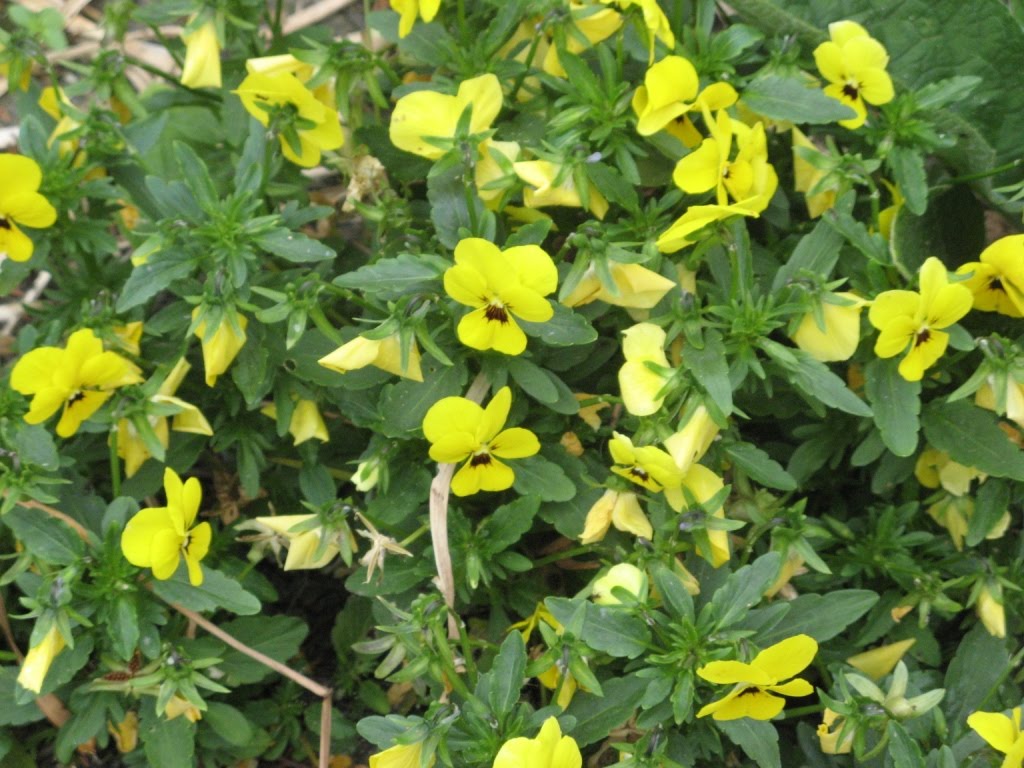
The pansies which I'd planted last year were hanging on in there ...


The roses were trying hard ...


And there were several little geraniums scattered around...


The weigela was past its best but still splendid ...


And when I finally got the weeds out ...


...I found that three of the runner beans which I'd thrown in in April, had made it. I imagine the rest succumbed to the unusually severe temperatures which England suffered in early May. Will they survive the current exceptionally high temperatures (it's 31°C today, a friend tells me) with no-one there to water them?


That goes for all the other stuff I put in while I was there. It's not fair - England is just not supposed to have drought conditions in June ...


But maybe the stuff which has had time to get established will be OK. When I was there last year, I carefully replanted all the Michaelmas Daisies, Golden Rod and other self-seeded stuff in clumps. And in April I threw in a few seeds - such as the nasturtiums Briana sent me when Bilbo cam to stay. Once I'd got the weeds out, they seemed to be doing well.


The alyssum seeds which I'd scattered around had made it and were holding their own against the borage ...


And I found I was growing potatoes on the compost heap ...


And finally, my favourites - little clumps of campanula were bursting through everywhere .


I shall be back in a couple of weeks. Here's hoping that they all survive the heatwave ...


Sunday, May 30, 2010

You know it's summer when ...


You know it's summer when ...

- the wallflowers are only still there because you want to save the seeds.

- however long you spend deadheading the surfinia, when you turn round two minutes later there are more to do.

- you spot the first flowers on your tomato plants.

- you suddenly realise you're under attack.


- plants wilt pitifully under the midday sun...


... and the hot humid afternoons are punctuated by low growls of thunder and sudden, torrential rain.


Summer has arrived. Temperatures last week were up to about 28-29°C (82-84°F) on a couple of days, and though it's now down to about 23°/24° (73-75°F - average for the time of year) it already feels as if the humidity is starting to rise - 61% this evening. Not a problem yet, but I've already warned the family that the annual "oven strike" is about to start - no more roast dinners till the autumn. It's been a shock - two weeks ago I was saying that we still had the heating on and it was teeming with rain. Well, it still is - but we've changed from constant cold, wet downpours to hot, humid storms. Early this year - they're par for the course in June and July, but less so in May. Oh well, at least no-one's going to be worying about water shortages this year ...


Sunday, May 23, 2010

It's time to stop ...


... your chrysanthemums.

Back in March I talked about the chrysanthemum cuttings I'd taken, and how I wanted to see whether, as all the books told me, cuttings planted anew would give a better show than if I just left them on the plant. Here they were back then - three cuttings sheltered between the two mother plants.


And here they are now.


So far no contest. In terms of growth the old plants are far outstripping the babies. But of course there's plenty of time yet before they flower. So far the new plants must have been putting most of their energy into developing roots. So we still need to wait and see...

They do need attention though. As you can see from this one in an individual pot, what growth there has been is all upward.


Now if you want large, single blooms, that's fine. But if you'd prefer a mass of smaller ones, then you need to "stop" the plant - that is, pinch out the central growing tip so that side shoots will form and, eventually, flower.

If you really get into it, stopping is an art form all of its own. Should it be done once or twice? When exactly? How many side shoots should be encouraged to develop? It depends where you live, what you want the blooms for, even what cultivar you've got. Have a look at this site for an idea, but believe me - whole books have been written on the subject.

Luckily, unless you're trying to produce blooms for show purposes, you can be much more cavalier about it. I stop mine once when they get to about six inches in height, some time in May, and then let them get on with it. And the actual pinching out is easy. See the new little leaves growing at the top of the stem ?


Gone ....


And come November, they'll be bursting with blooms.


Sunday, May 16, 2010

Seduced


I had clear ideas for the balcony this year. It was going to be colour themed, with in-your-face containers of orange and purple muted by others of yellow and pale lilac broken up by white. Sunflowers were going to tower above calendula, zinnia and marigolds interspersed by surfinias, petunias and daisies with big, yellow centres and white petals. Black-eyed Susans were to twine their way up the canes behind. In the early part of the season, cheeky little violet pansies would poke through the foliage, to be replaced later by white and purple verbena.

And this year, I was determined. There was going to be no pink.


So where did these come from?

I was seduced. As I am every year. When I got to the supermarket and found these amazing Surfinia, Impatiens (Busy Lizzie) and New Guinea Impatiens in exactly the same amazing shade of deep pink - well, I succumbed weak-kneed.

I think I'm going to have to give up pretending I don't like pink. It's true, it's difficult to pair with other colours - but purple works fine, as these pelargoniums that I've got on the office balcony show. The purple pansies look great between the larger plants. And then, there's always white - which goes fine with everything.


And it's just as well I succumbed. because all the rest - most of which I've grown from seed - is way behind schedule. We've had the coldest, wettest May I ever remember. It started pouring down torrentially on May 3rd, and has barely stopped since. We've had roads flooding, trees down, rivers overflowing and at one point 100mm of rain in just three hours not far outside the city. Temperatures have been down to 12/14°C (53-57°F), and the heating has had to be turned on again - something I've never known happen in May. Needless to say it's had a huge impact on agriculture - I read one report saying that a third of the area devoted to sweet corn (a major crop in this area) would have to be completely resown and that potato production was 40% down on usual.


And it's not been much better on the balcony. Seedlings which should by now be bursting out in growth are still just sat there, peering at me through the grey, cloudy gloom, as if to say you want us to grow at these temperatures ?? And seeds planted in April haven't germinated at all.

There is one advantage. The red spider mite must be loathing every minute of it. Two years ago they'd hit by May 12th. Last year it was May 20th. But this year I suspect we'll have a bit of a respite. Thank you, rain. Thank you.


Anyway, while I'm waiting for the rest, I've turned to pink. But whatever the intended colour scheme, there is one pink plant that I'd never be without - my Lychnis coronaria (Rose campion). I grew it from seed which I saved from my London garden several years ago, and it's bloomed regularly on the balcony ever since. I love the grey-green foliage and the stark contrast it presents with the flowers. This year (and I'm not sure why) it's suddenly grown exponentially into an enormous plant. And that in a container on the back balcony where I've had little success with other plants. Note the one weedy sweet pea that's come up behind it - despite the fact that I sowed liberally. But the lychnis is thriving - it's even dwarfing the hollyhock beside it.

I've got a lot of Lychnis seedlings coming on, and the plan is to fill that container with them. It would be nice to find a climber that would grow up the back though, to set them off.


So here's to pink. I offer it for this year's May Garden Blogger's Bloom Day. And long may it grace the balcony.


Related Posts with Thumbnails