Sunday, February 06, 2011

The balcony is back...


In the last few days, temperatures have suddenly shot up. Walking home on Friday afternoon, I suddenly found myself unzipping my jacket and ripping off my woolly scarf because it was so warm. Don't know what the temperature was, but forecasts have been predicting anything up to 14°C (57°C) for Milan this weekend.

And on the way to the supermarket yesterday, I noticed that the new grass was coming through, and lawns were looking green again. Didn't even have to pretend to myself this year - it was clearly time time to uncover the balcony...


So this morning saw several hours of hard work out on the front. The fleece came off the containers huddled against the balcony wall and the dead stuff got thrown away. There was surprisingly little that hadn't made it, I was pleased to see. Most containers seemed more or less unscathed - like this one with the plants that surprised me by coming through last autumn (I'm more and more inclined to believe they're Montbretia), and a couple of Honesty.
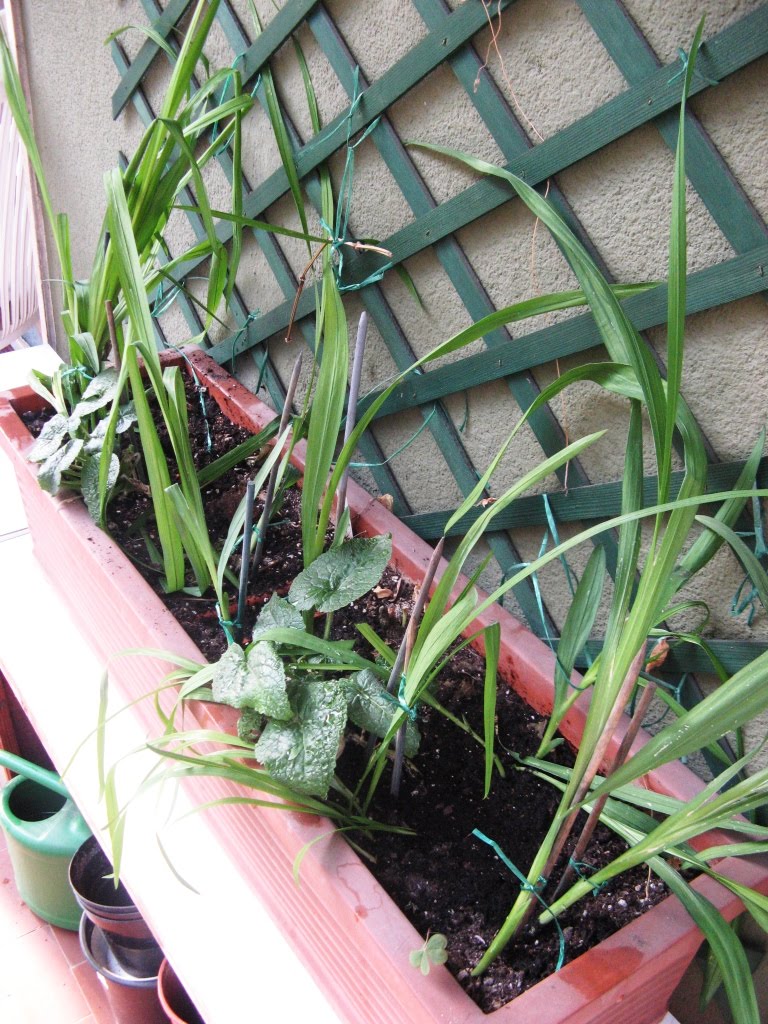

Next, the railings and container holders, as well as the drip trays and the containers themselves, all got washed down - as did the tables. And then the fun started ...

For the past ten days or so, I've been "collecting". A visit to the garden centre last Sunday saw me coming home with a couple of bags of primroses and pansies, and when I was at the supermarket yesterday, and saw them putting out stuff that had just come off the lorry - well I couldn't resist.

So in they went, together with some other plants that had been keeping warm under the fleece since the autumn - like the cyclament I blogged about then.


But I wasn't the only one who'd decided that spring is just around the corner and it's time to wake up and start work again. While I was potting up the new plants, I had a visitor...


The first bee of the year - obviously pleased that he'd found somewhere where there were a few flowers. And very welcome he was too. May he be the first of many.


By the time I came in to make lunch, the sun had hit the balcony and the thermometer was showing 18°C (64°F). I'd stripped off the heavy Norwegian style sweater I use for winter gardening (I can't bear gardening in a jacket) and winter seemed only a memory.


But no - I'm not that naive. It's still only the first week in February, and a quick look at the forecasts for the next few days show that though daytime temperatures are staying up around 14°, at night it's going as low as -2°(28°F). So (if sadly) I left the tenderer plants, like my plumbago, close to the house, and wrapped them up again in fleece. The primula and pansies should have no problems, but there are a few biennials that I'm more worried about. Like the plants in the first container above. I think they're daisies, but have to admit that I can't really remember. But it's easy enough just to pop the fleece on at night and off again in the morning, using bulldog clips to hold it.


So there we are. The winter may not be over. But for the moment it looks as if we might be heading for an early spring. Or have I spoken too soon...


Thursday, January 27, 2011

Starlings


My mother loathed starlings (sturnus vulgaris). She'd always put out bread for the birds, but then spend hours chasing off the starlings. Bullies she called them, only interested in "stealing" food from the little sparrows. Anthromorphism rules, OK.

There no longer seem to be either sparrows or starlings in my Lonon garden. I've posted before about the sparrow decline in London (they're still going strong in Milan fortunately), but the lack of starlings is odd. Because they're still in the area - the car park of our local supermarket is full of them. The cars don't daunt them in the slightest...


Why have they abandoned our area of parkland and gardens to move into a trading estate? No idea. Wouldn't have thought that an Asda car park was that rich on pickings. Could be the MacDonald's next door I suppose ...

Oi Bert! Them kids 'ave just dropped a carton. Sling us over a chip, would yer...

But perhaps it's not just that. According to the BBC Wildlife website, the population of starlings has dropped by 92% on previous figures. That certainly tallies with what I've seen in the garden.

Starlings are sensible birds. Some migrate, some don't - it depends where they live and what the winter conditions are like there. Birds from eastern Europe, where temperatures are harsh, will migrate, either to milder climates like Britain (is that why I no longer notice them so much - because I'm only there in the summer when numbers are reduced to the residents?) or south, to the real warmth. Here in Italy we see huge flocks arriving every year. Both in Milan and Rome, the sky outside the main station is often dark with them, and the air shrill with the squawking of up to 100,000 individuals. I wanted to make a video of them this year but (of course) missed them and had to make do with a few photos. During a walk down the Martesana canal in November, I noticed that they were gathering. Numbers were puny in comparison to some flocks that I've seen, but still dangerous. I had to go home and wash my hair afterwards...


Yet even a few who live in more temperate climes will sometimes up and go.
The RSPB site says "These birds are residents, and most never leave us..." - which presumably means that some do. So how do they decide ?

- Eh Fred. Decided what yer doin' fer yer 'olidays?
- 'allo Charlie. Well, yer know, things 'ave bin a bit tight recently. Me 'n the missis thought we might just stay at 'ome 'n 'ave a few days out. You?
- Oh going down ter Majorca fer a coupla months with the gang. Yer know who I mean?

Those that decide to stay at home sometimes find themselves in trouble when unexpectedly hard weather comes. This one, with 25 cms of snow on the ground, was reduced to attacking the feeders for the tits on my sister-in-law's balcony in Northern Germany this Christmas.


So if you've got some in your area, take no notice of my mother's prejudices. They're no longer the common garden bird that they once were. Ignore the pompous, aggressive strutting and squawking, and focus on that gorgeous metallic sheen on the plumage. Losing the starling would be as great a loss as losing the Bengal Tiger in my opinion. So put out some food and don't chase them off. Even starlings have to eat...

Sunday, January 23, 2011

Spathiphyllum


It has been bitterly cold here for the last few days, with temperatures dropping to -8° at night. And we're not even officially into the three "days of the blackbird" at the end of the month, traditionally always the coldest of the year. (Why "days of the blackbird"? I blogged about it a couple of years ago. You'll find it here)

So I've found myself putting off the clearing up jobs that are waiting for me on the balcony, and I've spent the time giving my houseplants some TLC instead.

I have very few in the flat. It's quite dark, and most plants suffer from the lack of light. In the summer, in fact, they stop being houseplants and go out on the balcony, but in winter have to come in to protect them from the cold. But I do have a bit more luck in my office.


One of my favourites (apart from my beloved Pothos, Scindapsus or whatever you want to call it) are these little Spathiphyllums, Peace lilies. I got them last autumn (a present from some students - thank you Module 3 people) and they've been super all winter, blooming their little hearts out.

Native to the rain forests of Central and South America, Spathiphyllum thrives in slightly shady conditions. And so is well at home in the office where, except on the sunniest days of summer, I need a light on constantly. Being a tropical plant, it does like to stay warm though -keep it at over 15°C (60°F).

They come in all sizes from small to medium to large. I'm not sure what this one is. Possibly Spathiphyllum wallisii "Chopin", a dwarf cultivar. It's tiny in comparison to other spathiphyllums I've had in the past.

As a rain forest plant it likes to stay moist - though not soggy. Let it dry out and it will flop horribly. Don't panic however - as long as you catch it quite quickly and water well, it will pick up again as if nothing had happened. It's only fainted.

Like all houseplants, it needs to be kept clean. If the leaves get dusty then their stomata ( the plant version of skin pores) get clogged. Plants absorb sunlight and carbon dioxide to create their own food in the form of sugars, releasing oxygen as a waste product. This process, called photosynthesis, is impossible (or at least inefficient) if the stomata are clogged, and the plant will suffer (wouldn't you?).

Plants growing outside will be washed regularly by the rain, but in the house (or on a balcony) they need cleaning regularly. Use a soft sponge or cloth dipped in tepid water. You'll usually be horrified at how much muck comes off.

Smallish plants with tough leaves (like Scindapsus) can also be popped into the sink under a gentle stream of tepid water and given a shower. This is also a good way of getting rid of any pests like aphids and the dreaded red spider mite. Make sure though that any excess water that gets into the soil is allowed to drain off immediately.

Sunday, January 16, 2011

Mini-plants


We're having a cold, nasty January. Temperatures aren't bad - around 2-3°C - but it's been foggy for days. Which means it's been a miserable, damp type of cold and everything is grey and dark. Summer mist can be beautiful. Winter fog isn't.

Needless to say not much is happening on the balcony, and I'm getting itchy. I want to get going again, but know it's too early. So when I saw these mini-houseplants in the supermarket yesterday, all at 1,50€, I didn't stand a chance of resisting. They were being sold separately, but I loved the contrasting leaf colours and thought they'd look good together. And bought them.


Dangerous. Because I had no idea what they were and what conditions they needed. The supermarket label announced that they were "piantine verdi" - small green plants. Wow, that's helpful. Did they need the same type of soil? Did they like the same amount of water. No idea. Buying plants without knowing what they are is, of course, the one thing you should never do. But you do, don't you? Please tell me it's not just me.

Anyway, once home, out came my wonderful, very old and very well thumbed houseplant book*. And I think I've managed to identify them all (I think - tell me if you disagree). They are, starting with the plant with the pink leaves at the back (weren't these supposed to be small green plants?) and moving around in clockwise order :

1. The Polka Dot plant
(Hypoestes phyllostachya also known as H. sanguinolenta) : Originally from Madagascar and likes warmth and humidity. No problem. Is also happy in shade good. My living room gets very little natural light. Can grow up to 2ft, so need their growing tips pinched out to stop them becoming straggly. Still no problem ..

2. Ivy
(Hedera) : Well, OK, I didn't really need to look this one up. Good in situations of poor light (phew!) and doesn't seem to be fussy about anything else.

3. The Aluminium plant
(Pilea cadierei) : I think this might be my favourite of the five - I loved the contrasting green and grey of the leaves. Native to Vietnam and sensitive to magnesium deficiency - needs a good dose of Epsom salts occasionally (a teaspoon in a pint of water.) That can be arranged. Likes a moist soil - no problems so far.

4.
This one caused me a few problems. I couldn't find it at all. However, when I turned to the net it popped up on Plants are the Strangest People. It's a Peperomia, though I've not been able to identify the variety. My houseplant book does list them, but there are around 1,000 species in the genus and, not surprisingly, mine wasn't the one they'd chosen to illustrate. Doesn't like to be too moist and not keen on humidity.

5. Pellonia
(possibly Pellonia daveauava - try spelling that without looking three times) : Again likes warmth, humidity and moist soil.

So - the only problem might be the Peperomia, which seems to like cooler, drier conditions than the rest. Could have been worse, I suppose...

References

What is my wonderful, very old and well-thumbed houseplant book ?

Friday, January 07, 2011

Thank goodness for garlic... Part Two


When I was a child, growing up in South London, garlic was the epitome of foreignness. My mother wouldn't have touched it with a bargepole. It was one of those things, like snails, that the French ate, and therefore decidely beyond the pale. (When I got older, I did once point out that she would eat winkles at every chance she got, but received the reply, "Yes, but they're food.")


Back to garlic. Suffice to say that I had to wait till I left home before I discovered what it could do for food - eating it was one of those daring, "forbidden" new experiences which awaited me when I got to university.(Don't get excited - the others were things like curry and stirfries. Food plays a large part in my memories of uni.) And I was immediately hooked.

One of the reasons I'm obsessing over garlic at the moment is that it's the featured plant on this month's page of the garden calendar that I found under the Christmas tree this year. Santa (in the guise of my sister-in-law) brings me one every year. It's always garden related, and it gets pride of place in the kitchen all year. This year the focus is on herbs and spices, and January is garlic.

I talked in Part One of this post about how useful it is to deter insects and fungi in the garden. But of course, as well as being good for plants, it's equally good for us. Leaving aside its folkloristic reputation of protecting against the plague and vampires (though it might not hurt to take the odd plait with you next time you happen to be in Transylvania), it's recognised as being
good for the heart, and as protecting against some forms of cancer. This in addition of course to the anti-bacterial properties - something I tried out at Christmas when I managed to slice open my finger with a knife I'd been using to chop the stuff. Can't say it was the pleasantest experience I've ever had, but boy did that cut stay clean...

What was I making at the time? Garlic bread - one of those totally simple foods that always tastes as if it originated in heaven. I always make it to accompany roast chicken and turkey - I'll leave you to guess which I was cooking on Christmas day - but it goes well with a lot of pasta dishes, peppers, all sorts of things.


The easiest way to make it is just to make some vertical slashes in a baguette type loaf (or whatever you can get that's similar), and stuff each slash with a slice of butter and a slice of raw garlic. However, an alternative is to soften the butter first, crush the garlic, and mix the two together along with some finely chopped herbs - I usually use chives or parsley. Then stuff the cuts in the bread with the mix, as before.

Wrap the lot in foil and pop it in the oven at about 400F/200C/gas mark 6 for about ten minutes till the crust is crispy and golden.


OK - it's not the recipe to use if you've got a cholesterol problem or are trying to lose weight. Garlic is often touted as a way to lower cholesterol, but recent research doesn't seem to support the claim. I suspect this sort of garlic bread, with its heavy dependence on butter, was originally a French recipe. If you want something a bit more healthy, there is of course the Italian version, bruschetta, which is just slices of toasted bread plus garlic and tomato. I love Italian food, and much of the best of it are the traditional recipes of the poorer part of the population - one of the most delicious things I ever tasted was Panzanella - a "salad" made with stale bread, oil and tomatoes - a recipe invented so as not to waste left-over bread.

But back to bruschetta. To make bruschetta properly, you need unsalted Tuscan bread and to toast it over an open fire. If that's not possible, use what you can - but bear in mind that you need a trip to Italy if you're going to really understand what's so great about it. Rub a clove of garlic into the toasted bread, dribble some good olive oil over the top, add a bit of salt and a round of very thinly sliced tomato sprinkled with oregano. If all the ingredients are fresh and good quality, it's heaven.


Wednesday, January 05, 2011

Thank goodness for garlic... Part One


It's that time of year again. Mid-winter. The time when you look around desperately for something to do in the garden and can't find anything. Christmas kept you occupied for a bit so you didn't have to think about it, but now...

So thank goodness for garlic. Garlic actually wants to be planted in winter. It needs a while in cold conditions in order to start growing. If you're late, you can always stick it in the fridge for a few weeks before you plant, but what gardener would want to pass up on the chance of having something that really, really wants to be sown in January?

January may seem a bit late. The advice on when to sow that you'll find in the gardening books and websites ranges from late October to early spring. But the
BBC Gardener's World website says November to January, and that's good enough for me.

I'm sowing in seed trays for now, and will transfer the plants to the containers later on. The Gardener's World website explains how (follow the link above) - or if you speak Italian try a great blog that I've just come across
Un pugno di terra e un seme (which translates as A fistful of soil and a seed).

I shall be using the garlic mainly as companion plants to deter pests - harvesting is a lower priority. Garlic supposed to deter just about anything - aphids, red spider mite, colorado beetle, and boring insects (no, not uninteresting ones, but the type that eat into woody stems and branches). You name it and someone will suggest garlic as a remedy. It's also supposed to prevent a variety of diseases - peach leaf curl, apple scab, sooty mold, black spot... All sources however, warn against planting it near peas, beans and other legumes - annoyingly without explaining why. It might possibly be because the antibiotic properties kill off the bacteria which fix the nitrogen produced by legumes in the soil. But I'm hypothesising wildly there. Does anyone know?

Even if you don't want to grow garlic around your plants, you can buy some and use it as a home-made anti-fungal spray. Crush or blend the cloves from three large heads of garlic into about half a litre of water. Leave it to stand and then strain the bits out (or they'll clog up the tube of your spray). Breaking up the tissues of the garlic during the crushing releases a chemical substance called allicin which has antibiotic and anti-fungal properties. I've used it regularly and it seems to work. Not recommended, however, for houseplants. It works all right, but the smell does linger...

Garlic oil is also recommended as a deterrent for slugs and snails. That's one problem you don't get on a balcony, so I can't vouch for whether it works, but it would be worth a try.

As I'm not primarily growing the garlic as a crop, I didn't bother too much about the quality of the cloves, and just stuck in some which I got from the supermarket. If you do this though, make sure that you use organically grown garlic, as otherwise it may have been treated with chemicals expressly to stop it germinating. Another reason for the "lazy" choice is that there's nowhere around here that I can get seed garlic, and my first attempts at sourcing it through the internet only came up with places which either didn't deliver to Europe or only sold it in quantities that were far too large for the balcony.

However, I've now found
The Garlic Farm which sells everything you could possibly think of related to garlic, and which has gone firmly onto my list of places to visit the next time I'm on the Isle of Wight. As my last visit was forty-five years ago, a new trip is long overdue. They sell lots of varieties of seed garlic - and will deliver to Europe - and browsing their site has made me think I might just invest in some of the good stuff. Especially as it seems that last year there was a garlic shortage and prices sky-rocketed. Why? Because apparently, a lot of the garlic we eat comes from China, and fears of bird 'flu there meant that domestic supplies were hoarded. No, as far as I know there's no evidence that garlic protects against bird 'flu, but a lot of Chinese seem convinced it does.

I don't know whether the situation will be repeated in 2011 or not, but the thought of the carbon footprint that the garlic I'm using might have clocked up is quite enough to convince me that growing my own might not be a bad idea. And until then, I shall certainly be looking at the labels to make sure that what I buy comes from slightly nearer home - as I said, the stuff that I've planted is organic, and though the packaging doesn't state the origin, it does say that the cultivation methods conformed to the
EU regulation 2092/91 which suggests that it comes from slightly nearer home than China, at least.

But if I'm going to grow my own, what varieties will I choose? The Garlic Farm's list had be hopping from one foot to the other like a child in a sweetshop. Should I go for softneck garlic, the type you normally find in the supermarket, which is easy to grow and store - or hardneck garlic, which tastes better? What about trying elephant garlic, with it's huge sweeter tasting cloves? Or should I just go for the Garlic Lover's Seed Selection which will give me nine different varieties and a hundred plants...

A hundred plants. Erm... wasn't that the quantity I didn't reckon I could cope with on the balcony? And aren't even the air miles between the Isle of Wight and Milan a bit exaggerated? It may not be China, but it's hardly local produce.

There are times when trying to live sustainably can be very difficult ...


Monday, January 03, 2011

Look what they've done to my balcony...


As usual we spent the Christmas and New Year period in Germany. We left Italy just as a lot of European airports were being shut for snow, and thinking that it might turn south, I made sure to fill up the bird feeders before we left.


In fact, while most of the continent had a very white Christmas, Milan only had rain. That didn't deter the birds though. The great tits are clearly at the more respectable end of the bird community. They've been pecking their way gentilely through the peanuts,and I'm expecting a thank-you card to arrive soon. The sparrows, on the other hand, are a bunch of deliquents who clearly saw the bird-seed container as an invitation to vandalise the whole place.


The balcony looks as though a bomb has hit it, and I hate to think what I'm going to find growing in that container next year. On the plus side, I don't think I'm going to have to buy any fertiliser. By the time I've scraped up all the droppings, I'm going to have enough guano to last a couple of seasons...

In Germany, with all the snow that was around, the birds were virtually dependent on feeders and it was a great chance to spot a few types that we don't get here. Apart from the ubiquitous great tits and blue tits, I also saw some long-tailed tits, greenfinches and chaffinches, a nuthatch...


...and a tree-creeper.


Forgive the lousy photos - I had my camera on the wrong setting without noticing it.

There were various raptors around too. I saw a lot of buzzards in the woods, and a dead blackbird's head and mass of feathers in the snow on New Year's Day suggested we'd been visited by a sparrowhawk in the early morning.


Saturday, December 11, 2010

Looking after the snails


So there I was last Sunday evening, washing the turnip tops ready for dinner, when I found a snail. Well, it happens. He seemed to have survived 24 hours in the fridge quite happily, and was clearly perking up, so I popped him on my spider plant while I decided what to do with him. And then I found another one ... and another one... and ...


By the time I'd finished I had five of them - and quite honestly had lost most of my desire for turnip tops that night. But what was I going to do with them? Temperatures outside were well below zero, and a quick look at the internet said that snails freeze if they haven't got themselves into a well-protected position before temperatures drop. And whilst one on the balcony chomping away at the plants probably wouldn't have done much harm (they were very small), I wasn't sure I wanted five of them running rampage for the whole winter.

So the snailery was born. A large glass vase covered with clingfilm with airholes punched in. And the five of them - Fred, George, Ron, Bill and Percy - have been happily chomping away on a basil plant, plus various vegetable peelings that I've popped in for them, for the past week.


OK, OK. Like my family you probably now have that expression on your face which says This time she's really flipped - but I am not alone. I have discovered a whole website dedicated to keeping snails as pets...

And oh dear - I find I have to get my act together. I've got to provide them with calcium, cook their carrots and potatoes, stock up with tortoise food in case I get snowed in and can't provide them with fresh greens, make sure they have somewhere to lay their eggs, protect them from mites ...

I'm not entirely sure whether I'm supposed to take them for regular walks - but I suppose come spring a few excursions on the balcony might be in order...

Monday, November 29, 2010

The Chrysanthemum Experiment - Results


This year I've been experimenting with my chrysanthemums. I have some little yellow ones which I've been growing for years now. Every year I leave the old plants till early spring, and then take cuttings from the new growth. That's what all the books tell you to do, saying that the old plants will never produce such good blooms in subsequent years. Was it true? This year I decided to try it out.


If you click here, you'll find the posts I wrote in March (when I took the cuttings) and May (when they'd taken and it was time to "stop" all them in order to convince them to put out side shoots). But I've reproduced the photos to show you the main stages. I took cuttings, but didn't throw the old plants away. Instead I planted the cuttings in the same container, in between the older ones.


Why? well firstly to fill the gaps left by a couple that had died over the winter. But also to ensure that the soil, water, light and fertiliser conditions were identical for both sets of plants. As any primary school child will tell you, an experiment is only a "fair test" if one variable, and one only had been changed. In this case the variable was old plants vs cuttings. Everything else was identical.

Back in May, the new plants looked pretty puny in comparison with the old. But by the time autumn arrived, I could only remember which was which by going back to the spring photos to check.


By October they were covered in buds. Whichever won, it was going to be a good year. And, when the buds opened, it was immediately clear that...


... there was no difference at all. Both sets of plants are full of flowers, the flowers are all of the same size, and I can see no difference of any kind.

So will I be taking cuttings next year? Yes, certainly. But to increase the number of plants I have, not to replace the old ones. From now on, my chrysanths can go on for as long as they feel like it...

Sunday, November 28, 2010

The Canal in Autumn


This year's autumn colours were amazing - I don't remember ever having seen anything like it in this area. I imagine it was something to do with the weather - just the right amount of rain at the right time, just the right temperatures.... something like that.


But it was so beautiful, that one day we walked down the canal just to take some photos...


Most of the trees here turn yellow or brown - there are very few reds ...


Just a few ornamental maples that have been planted, and then this hydrangea that was peeking through the undergrowth...


The Virginia Creeper looked as if it knew it should be red, but was trying desperately to blend in with its surroundings..


And with yellows and browns like these around, who could blame it?


These aren't leaves, but seeds, sycamore type. Thousands and thousands of them.


We walked for a couple of hours...


And by the time we got back, it was almost dark.


Related Posts with Thumbnails