Wednesday, January 24, 2007

Curious Incidents ...

If you’re looking for something different to read, try Curious Incidents in the Garden at Night-Time : The Fantastic Story of the Disappearing Night by Allan Shepherd. Published by the Centre for Alternative Technology Publications, it starts off as an extended short story – the story of an amateur naturalist who is passionate about moths, and who has designed his garden to contain night-scented plants which will attract them. Each night he records the species he captures, (he doesn’t kill them, just collects and records the species then lets them go), and notes which ones are slowly disappearing due to global warming and other factors. The blurb on the cover uses words like magical, eloquent and beautifully written and I’d add beautifully illustrated and designed. At the end of the book Shepherd lists his inspirations, which are The Curious Incident of the Dog at Night-time, The Little Prince, To Kill a Mockingbird, Walden and the film It’s a Wonderful Life. If you know these and can imagine them all rolled up into one book, that’s what this book is. And like these books, the overall feeling is positive. He’s talking about the extinction of thousands of species, but the end of the story suggests that there is, after all, hope.

The unusual part of the book, though, is not the story at all. The moth collector keeps a notebook on ecology, called the Memory Book. The second part of Curious Incidents are extracts from the Memory Book, which is partially on gardening – in particular creating a garden to attract wildlife in general and moths in particular – partially on evolution, global warming, and partially on the moth collector’s own memories (though these extracts are included in the first half rather than the second). It includes extracts from other writers, results of the moth collector’s own research, web references, and lovely illustrations.

I received the book as a present, and it couldn’t have been better chosen - thank you, Alison. You can find it on Amazon, along with some other of Shepherd's books.
I think The Little Book of Garden Villains looks quite fun …


Monday, January 22, 2007

Sage Advice


At the beginning of the year I promised to tell you each month what was on the super plant calendar which I got for Christmas. The plant on the January page is sage – salvia officinalis.

Officinalis in the name means that it’s considered a medicinal plant, and in fact the calendar specifically features plants which can be used in herbal remedies. The name salvia comes from the Latin verb meaning to save and, according to the calendar, there’s an Arab proverb which says Why should anyone die when they’ve got sage in the garden? - although
Wikipedia attributes that one to Martin Luther. There’s also supposed to be an English saying which goes Eat sage in May and you’ll not die, but I can’t say I’ve ever heard of it before.


Most of the remedies the calendar describes were already familiar – sage is good in a mouthwash for sore throats, inflamed gums and so on. But it also said that it’s good for the digestion and that it contains flavenoids which fight free radicals and strengthen the immune system. And the one that I hadn’t heard of at all was that, combined in a tea with other ingredients it helps stop hot flashes during the menopause. The recipe for that was to combine 20g each of sage,
hops, hawthorn, lemon balm (Melissa officinalis), and downy hemp nettle, and combine 2 tablespoons of the mixture with hot water. Let it stand for five minutes before straining. Two hours before going to bed, you drink two cups of the stuff, lukewarm. Can’t say I’ve tried it because I’m not sure where to get my hands on some downy hemp nettle, but if I do I’ll let you know if it works. We’ll see if the medicinal sections are a bit more authoritative than the proverbs.

Joking apart, if you do want to try it, the writer (Ursel Buehring) is a well-known German writer and presenter of TV programmes on herbal remedies, so she should know what she’s talking about. On some of the other pages there are warnings about possible side effects and so on, but nothing is mentioned here. I’ve checked all the herbs though, and it seems you should be careful of hawthorn if you’re already on heart medication, and hops if you suffer from depression. And don’t be tempted to go and pick downy hemp nettle yourself unless you’re sure you know what you’re doing – other members of the genus are poisonous. All in all, perhaps I’ll give this one a miss – but I’ve added links to descriptions of the herbs if you want to check them out for yourselves.

Saturday, January 20, 2007

Primroses and hurricanes

The crazy weather continues and half of Europe has had a hurricane. It stopped at the Alps and we’ve not had so much as a breeze here, but the TV pictures have been horrific. I’ve just done a round of UK blogs to see if anyone had posted about it, but it’s too early. They’re probably still all out clearing up.


Instead we’ve been basking in the sunshine. Temperatures were 27°C in Turin yesterday – that’s about 80°F. We “only” had 18°C (about 65°F) and today it’s dropped to 14° but that’s still spring temperatures. In January I would expect it to be somewhere between -6 and +5°. The plants don’t know if they’re coming or going (literally) and, according to the TV, yesterday there were butterflies fluttering around. I went out to do a general tidy up this morning (and to enjoy the sunshine) and saw that I’ve got annuals from last year – nasturtiums, alyssum, petunias and so on - that are still going strong, and that loads of stuff which has self-seeded is starting to come through. I’d be tempted to start sowing other stuff – except that they say there’s snow on the way for next week. The sudden drop in temperature will probably kill off a lot of things, so I’ll cover everything with fleece on Monday in an attempt to lessen the shock.

I have succumbed to the early spring feeling though – I went out and bought some primroses . They’re probably my favourite spring flower, and when I go and buy them I always feel that the growing year is starting up again. I have to get them each year from the nursery as, try as I might, I can’t keep them over the summer – the heat and direct sunlight of the balcony is just too extreme for them. Last year I made a special effort to keep them cool and shaded, and actually got one through to September. But in order to shade it I had to hide it so well that I then forgot about it for a week – and found it eaten up by red spider mite.

Monday, January 15, 2007

Tagged!

The photo is from back in November, but it's one I never got around to posting ...

There’s a game of virtual tag circulating the net at the moment, and as I’ve been tagged twice in the past couple of days, I decided I can’t really get out of it. My taggers were
She who digs and James – who’s not a gardener as far as I know but works in EFL as I do, though he also seems to run a thousand and one blogs and sites on different topics.

The idea is that if you’re tagged you have to tell people five things they didn’t already know about you (and probably didn’t want to, but never mind). So here goes. I’ve been racking my brains for things related at least vaguely to gardening, but haven’t come up with much, so you’ll have to put up with some general stuff.

1. Not so much about me, but a memory from school – and this one at least is about gardening. When I was a child London County Council (yes, that long ago) used to give every school child a couple of daffodil bulbs in the autumn and a few candytuft and clarkia seeds in the spring, and there was a competition. You grew your plants in a pot and then they were judged and you got a grade like highly commended or whatever. I bet they don’t do it any more, but what a pity. I remember really enjoying growing them, and who knows how many kids developed an interest in gardening later in life due to that first experience.

2. I used to be very into amateur theatre and when I was at university was one of four local organisers for the National Student Drama Festival – probably one of the best weeks of my life, even though it probably also shortened it considerably. I probably wouldn’t have thought about it except that the other day I found a list on the net of all the past festivals, the performances at each and the organisers. And there I was.

3. I once got vetted by MI6 because I’d been teaching a guy who turned out to be a Bulgarian spy and got thrown out of the country – the spy, not me.

4. I would love to go into outer space and my biggest regret is that by the time space travel is an everyday occurrence, I won’t be.

5. One thing I have to admit – I talk to teddy bears.

Now I have to tag other people who I'd like to know more about – sorry about this folks. So it’s
Carol and John for gardening and Katie for EFL. I think it’s supposed to be five others, but I can’t afford that many enemies ….

Thursday, January 04, 2007

Happy New Year!


Happy New Year! First of all, here are the answers to the Christmas quiz (because I know you can’t wait) : 1b (my Christmas sprouts had obviously been well frosted, because they were delicious), 2c (don't try this at home), 3a, 4c, and 5 mistletoe.


I hope you had a good Christmas holiday. One person who certainly did was Trillium, who won the BBC Gardener of the Year award. Well, she really won it in the autumn, but couldn’t tell anyone until the programme was shown last Saturday. Luckily she had the sense to keep a secret blog describing what happened during the days of the competition and it’s now on-line. As it’s in blog format, you have to go back to the earliest posts and read it in date order, but it’s well worth the scrolling. You can also find out about it on the
BBC website. And just in case anyone is wondering, Joe Swift - the presenter of the programme - is not, as far as I know, any relation. But he does seem to have the Swift chin, not to mention a very similar hairline to other males of the family. In fact he bears a decided resemblance to my brother .... perhaps I should do some research.


My Christmas was great. As usual we went to Aachen in Germany where my sister-in-law lives. We usually spend half the time tobogganing, but this year it was so mild, there was no chance. Except for Christmas Day when it suddenly, and temporarily, dropped to minus 3°. As it had been plus 8° the day before, the condensation just covered all the trees and plants with ice. These photos were taken on Christmas morning, when we went out for a walk after we’d opened our presents.


But not the next one. Before I went away, I decided to move all my plants next to the walls of the house, and cover the most delicate with fleece, just in case the temperature dropped while we were gone. And look what I found – a petunia in bloom on December 21st. If that’s not evidence for climate change, I’m not sure what is.


I had two gardening related presents this year. Firstly, a calendar focusing on a different plant each month and the herbal remedies associated with it. It’s in German so I’ll have to get my dictionary out, but I’ll let you know month by month what it says. And the second one was from some friends who gave me this lovely set of cards and envelopes, homemade with photos of flowers from their own garden. A super idea and one I shall copy next year.

Tuesday, December 19, 2006

Christmas Quiz

Do you like our Christmas tree? We started our own family tradition when my son was small - there was no point getting another one when we already had a seven foot monster dominating our (very small) sitting room and we were going away for Christmas anyway. But now, even when we stay at home, it doesn't seem necessary - this is "our" Christmas tree.

Christmas is a time for quizzes, so here's one for you about some common Christmas plants. I'll put the answers up after the holidays, but if you can't wait, you'll find all the answers on the net (I did!).

1. For me Christmas dinner isn't Christmas dinner without brussel sprouts. It's well known that they taste better after the frost has got to them - but why?
a. The frost kills the plant, which is then preserved because frozen, but becomes tenderer as it slowly decays.
b. Sugar replaces water in the cells to protect them from the cold, and so they become sweeter.
c. The frost breaks up the ground and allows more oxygen to get to the roots.
d. Actually, this is an old wives tale - it makes no difference at all. The important thing is that they've had longer to grow.

2.
What was the sap of the Poinsettia used for in the 14th-16th centuries ?
a. as a poison b. to flavour soups c. as a cure for fever d. as a cure for nausea

3.
According to Pliny the Elder, holly flowers had the ability to :
a. turn water to ice b. turn iron to gold c. protect against evil spirits d. revive the dead

4.
Fir trees were used as a symbol of Christianity from the 7th century, and by the 12th century were Christmas symbols. But what was different about the way they were used?
a. They were burnt as a ritual sacrifice b. They were eaten on Christmas Day c. They were hung upside down from the ceiling d. They were worshipped

5.
Only one native British plant has white berries. What is it?
a-d. Oh come on, you don't need clues for this one :)


Doubt if I'll have time to post again till after Christmas, so ....

Happy Christmas to everyone!

Blogger strikes again ?


Has anyone else had problems with their comments recently? For some reason I'm not getting E-mail notification of mine any more ( I won't blame Blogger for that - I probably clicked on the wrong button and blocked the address instead of cancelling the message or something), but I'm also having trouble publishing them. In particular, the system "ate" one message from Lou Laz, so I thought I'd answer her question here.

Lou Laz wrote saying that she was going to be in Milan and wanted to buy seeds while she was here. It's not that easy. As you'll see when you arrive, Milan is all apartment blocks - almost no-one has a garden, and consequently all that the garden centres, supermarkets and street markets stock are fully grown plants, houseplants and in summer balcony plants mainly. If you go to the outskirts and to the roads leading out of town, you'll find more garden centres catering also to people with gardens, but in town the only place that I know that has a really good stock is Fratelli Ingegnoli of Viale Pasubio (they have another centre too, in Via Mecenate - depends which area you're staying in). Their website is here.


Back to the balcony ..... The mild weather has really made a difference this year. By now, I usually have everything stacked against the wall of the house and covered in fleece, but this year not only has it not been necessary, but also everything is still flowering in a way unheard of for December. All the photos here were taken during the last few days. It was the warmest November for thirty years - so warm that they weren't even able to use artificial snow on the ski slopes of the Alps until just this last week or so, let alone hope for the real thing. The four day weekend which we had last week is usually the start of the ski season, but this year there was no chance. As the whole economy of that area depends on the ski trade, it's a big problem. The temperature has dropped a bit now - we had our first frost the other day, though it's back to 7° today - but still nothing like usual.

Sunday, December 10, 2006

Unidentified Flowering Objects


Every so often this summer I came across plants I liked, but couldn't put a name to. Where possible I took a photo so that I could try and identify them later. I've managed with quite a few but I'm still stuck on the four in the photos. Does anyone recognise them?


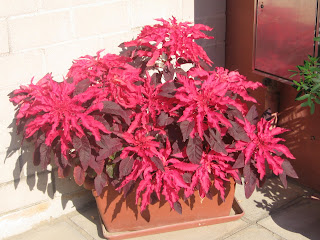
The first two were taken while I was on holiday in Caorle this August. I fell in love with both of the plants, but especially with the second one. I'm not usually a great fan of foliage plants, but I'd readily find a place on the balcony for this one. I've never seen another plant with quite the same colours, and I loved the contrast between the deep and bright pink. However, despite scouring garden centres and houseplant books, I've not been able to find either of them.


This, on the other hand, is one of the trees in the garden outside the balcony. It's deciduous, but winter is the only time it doesn't look good. Not only does it have an attractive shape and pretty leaves, but in summer (this is another August photo) puts out masses of white flowers. By late September, these have turned to clusters of bright red berries.


Finally, a climber I spotted when I was in Casablanca last month. It still had a lot of flowers even then, though the even greater number of seed pods showed that it was at the end of the flowering season.

Any suggestions?

Thursday, November 30, 2006

A Walk in the Park


I had two appointments this morning, by chance both on opposite sides of one of Milan's big central parks. The first one finished earlier than I expected, and I found myself with forty five minutes to kill. It was a glorious day - about fifteen degrees, bright sunshine and a clear blue sky, and instead of jumping on the tram as I'd planned, I decided to walk through the park.


I knew the trees were going to be stupendous even before I got inside, and I wasn't disappointed. Of course, I didn't have my camera with me, but I rushed around picking up leaves (good job I didn't have to open my briefcase when I got to my next client) for the scanner. Yes, I know I'd promised myself I wasn't going to spend any more time playing with the scanner when I should be working, but it was stronger than I was.


The yellow leaves are gingko - the tree I talked about in the last post. But I'm not sure about the others. Trees are not my strong point- I can manage the most common British ones but that's about all. The pointy one is perhaps some sort of maple? And the green and yellow ones are lime? But I give up on the red ones. They're about five inches long, and the ones that hadn't yet turned red were a bright orange colour. For some reason it didn't come out well on the scanner, so I excluded them from the pictures.


Friday, November 24, 2006

Autumn

Autumn is full swing here now, although up to now temperatures have still been fairly mild - it's about 10° today, and that's more or less the lowest daytime temperature we've had. But it's been quite windy some days and the leaves are falling fast - I've been collecting them for scanner photos.


I wished I'd had my camera yesterday as I went down a road lined with gingko trees. Gingkos are used quite a lot in Milan as roadside trees and in the autumn are just a mass of yellow leaves. I was on the bus unfortunately, so couldn't steal one for the scanner. I'll have to find time to go back ...

For those of you who asked, I've still not been able to make the Chrysanthemum photo from a couple of posts ago clickable. I don't know why. These ones aren't either, so it must be something to do with them coming from the scanner and not the camera.


I'm still swamped with work and have hardly put my nose out on the balcony this week. I must find the time this weekend as there are bulbs still to be planted and things need moving into their winter positions. I suspect that when the temperature does drop it will do so with a vengeance.

The change in the birds that are around is a sure sign of winter coming. The starlings that a couple of weeks ago were massed in hundreds of thousands over the city are now long gone, and this morning I saw a robin in the garden. The one we had last year (the same, or this one's Dad?) had clearly established the horse chestnut tree outside my bedroom window as the centre of his territory. All through the winter I was woken up at 2 am by his singing. I'd wake up and lie snug in bed listening to this beautiful liquid song. I hope he comes back this year ...


Related Posts with Thumbnails