Tuesday, August 11, 2009

Blast from the Past Tuesday : Five Things I Hate about Container Gardening Books


This week's Blast from the Past post comes from February 2008.


I have two types of gardening books on my bookshelves : the first are about gardening, the second are about container gardening.

The container gardening books have a different emphasis from the others. They're not so much about how to grow things, as what plants to combine to produce the most attractive containers. And at times they drive me mad. Here's why ...

1. The assumption that container gardening means patio gardening, or at least that you have a large terrace. If you can use enormous containers, raised beds and so on, its a whole different ball game from balcony gardening, and much of what you need to know is no different from gardening with a garden. The book often looks great, but relegates small container gardening to hardly more than a chapter. Container gardening should cover both possibilities - so give us balcony gardeners at least 50% of the space please.

2. The perfect pictures. Five different types of plant in the same container, all in flower and at their best, and all exactly complementary heights and lengths at exactly the same time. Yeah, yeah. Buy them from the garden centre, give them a week to settle and they'll be like that - for another week. But then one will shoot up, another will get attacked by pests, and a third will stop flowering. And the container will spend the rest of the summer looking tatty.

3. The one-sided pictures. The most difficult thing about balcony gardening is that all the light comes from one direction. So the plants lean towards it, away from the house, and the container ends up lop-sided with the plants trailing over the balcony railings away from you. All you get to see from your living room are the backs of flowers and leaves leaning away. And tall plants end up looking like the leaning tower of Pisa. Smaller containers can be turned regularly, but that doesn't help with the large fixed ones. Look at the one in the photo for example - super. But what's it like from the other side?

4. The perfect colour schemes, achieved only by going out to buy an exact variety of a plant. Phyllitis scolopendrium "Cristatum" - whaaat ? Here I'd be lucky if I could get the plant, let alone a specific variety. I have sometimes thought of going to our local garden centre with a list and saying "I'm looking for these." I suspect the reply would be the Italian equivalent of "What about some nice pelargoniums, luv?"

OK, OK - I'm just envious because my containers never look as good as the ones in the books. But that doesn't stop me yanking them out every spring, poring over the pictures and trying again. And buying more. Maybe this year ...


Don't let your old posts get lost! If you'd like to join in with Blast from the Past Tuesday (or Saturday or Sunday, whenever you like), just "revive" one of your favourite old posts from at least a year ago, with a brief explanation of when it's from and that you're "reviving" it for BFTP Tuesday, and leave a comment below with a link to your blog so that people can find it.


Sunday, August 09, 2009

Squirrel


My garden in London backs on to a park which is maintained as a wildlife sanctuary, and much of the wildlife finds its way across the back fence into the garden - especially when it knows that there's food on offer. One of the most frequent visitors is a little grey squirrel.

Grey squirrels aren't native to Britain. They were first introduced in 1876, from America. But they bred rapidly and soon took over from the native red squirrels, once widespread. There are now estimated to be about 2.5 million greys as opposed to only 120,00 - 160,000 reds, which are mostly found in the coniferous forests of Scotland.

Why has the red squirrel declined so dramatically in numbers? Destruction of the woodlands which are the red squirrel's natural habitat is one reason. The grey squirrel has a number of advantages when competing for food. It can eat acorns, which the red squirrel can't, and which are often now the main food source in the parks and woodlands where the greys are found (I just wish they'd remember where they bury them - you can't imagine how many sapling oaks I pull out of my garden each time I'm here.) In addition, where hazel nuts (a principal food source for the reds) are growing, the greys have the advantage of being able to eat them when they are still unripe - which the reds can't. The greys therefore get there first, leaving fewer for the reds.


But one of the main reasons for the drop in numbers seems to have been a virus called the parapox virus. The greys are unaffected by it, but evidence suggests that they can and do carry and spread it. And for the reds, it's deadly.


It's estimated that red squirrels will disappear from and area within 15 years of the introduction of the greys and they are now a protected species, with projects to reintroduce them to their natural habitats being carried out in various places. One highly successful case was in Anglesey in North Wales, where culling the greys resulted in the re-establishment of a thriving population of reds.


The greys, on the other hand, are seen as vermin and can be legally killed. Local DIY shops and gardening centres here are full of squirrel traps. You do need the permission of the landowner to set them however, so if any of my future tenants are reading this - you don't have it. If there is any control to be done, I feel it should be done in a planned way by the authorities, not by individuals. And in fact research is apparently being done to find an oral contraceptive which can be left where the greys will eat it but not other animals. Squirrels on the pill - the mind boggles. But a far more acceptable solution to my mind than people taking the problem into their own hands.


I like the squirrels though and wouldn't want to lose them from my garden. Yes, they can be a nuisance. They raid the bird feeders and the fruit trees, dig holes in the garden to bury their nuts and acorns, and dig up and eat the flower bulbs. (Yikes, I bought 200 daffodil bulbs to plant in the garden the other day - that should keep ours going for a couple of weeks.) And more seriously, they will eat birds eggs and baby birds. But they're fun to watch and brighten up the garden considerably. And they provide interest for our neighbours' cat, who is convinced that one of these days he'll be quick enough to catch one. Not a hope in hell. They just leap across the garden, whizz up a tree and sit at laugh at him. I swear I saw one throwing a nut down at him the other day ...


Sources

National Geographic News
UK Biodiversity Action Plan
London Evening Standard
The Friends of the Anglesey Red Squirrels


Thursday, August 06, 2009

Skywatch Friday - London Clouds


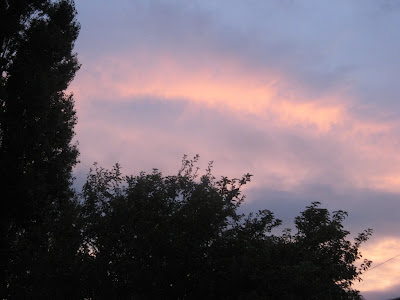
The clouds in London fascinate me. We just don't have anything like them in Milan. Doesn't this look as if it should come out of a film like Independence Day? They seem so close and so menacing that you feel they must be hiding something ...
As always there are loads of other great sky photos over at the Skywatch Friday site. My favourite this week? Living on the Edge, from Canada.


Wednesday, August 05, 2009

Secret Gardens


A couple of posts ago I wrote about the Mulberry tree in Charlton Park, reputedly the oldest in Britain. I wonder how many people know that behind what used to be the old stable block of Charlton House, the large Jacobean manor house that stands at the front of the park, there is a series of walled gardens.


They're hidden away, behind trees and bushes, and you could easily never find them even if you walked through the main part of the park every day. I discovered them as a child - my grandparents used to take me there, and at the time one was a rose garden (which my grandmother loved) and another had a long rectangular goldfish pond with waterlilies, where I would watch the fish for what then seemed like hours (probably about five minutes!)


The rose garden and goldfish pond are long gone, and there are five gardens not two. In addition to the two large rectangular ones which I remember, there are also three smaller, square gardens. I don't think many people go there. There were a couple of elderly people sitting quietly in the sunshine, but they were almost deserted.


I could have stayed in the gardens all morning. Each one seemed more peaceful than the next.


They are designed slightly differently one from the other. Some are quite formal, with neatly cut grass and shrubs. Others have huge swathes of large, dramatic looking plants and grasses. One has been designed as a butterfly garden. and in one, tucked in amongst the other plants, someone was growing their courgettes.


I loved this central bed with its anvil-like central sculpture and these wonderful tall lilac flower spikes. Can anyone identify them?


But my favourite was one of the smaller gardens which had this intriguing little gateway. I could have sat quietly in there for hours - except that you couldn't help but want to know what was on the other side ....


... the Amnesty International Peace Garden.


And that just about summed it up really. The gardens were a little oasis of peace and tranquillity where you could forget you were in the middle of London, forget you had work to to, and forget you had problems to solve. I'm glad I found them.


Tuesday, August 04, 2009

Blast from the Past Tuesday : A Day in the (Gardening) Life of ...


This week's Blast from the Past post comes from October 2006.

7.30 : I wake up and the house is still quiet. Saturday. I slide out of bed, go into the kitchen to make a cup of tea, and open the shutters. The outside thermometer says 18°C, so it’s just warm enough still to sit out on the balcony and have breakfast. Make the most of it – it won’t last long now that October has arrived. The balcony’s looking a mess – a general clear-up is necessary.
10.00 : Things are starting to improve. I’ve got rid of a few annuals which were looking tatty, and re-organised the containers so that the plants which are still blooming are near the windows. I don’t think the zinnias are ever going to stop. They’ve been going for over three months now, and are still showing buds.
10.30 : Have spent the last half hour dead-heading and seed collecting. The mirabilis jalapa is still flowering, but is now covered with seeds. I’ve already collected enough to start a nursery, but I can always give them away. Every so often I drop one and it falls off the balcony onto the path below where the little kids play. They’re poisonous, so I go down and spend ten minutes hunting for them just in case.
11.00 : Get out my gardening books and magazines to find out what I need to be doing this month. Planting out the biennials and generally preparing for winter it seems. I’m out of compost and am going to need some for the re-potting I want to do later. Time for a quick walk to the garden centre. I’m lucky – garden centres in Milan are few and far between but ours is only two minutes away. Otherwise it’s a trip out of town, or wait and see what they’ve got at the weekly street market. Resist heroically the temptation to buy more plants.
11.40 : Two bleary teenage eyes peer round the door onto the balcony inquiring if we’re having lunch soon or if it’s worth having breakfast. Seeing me up to my elbows in stable manure, he opts for cornflakes.
2.30 : Time for the weekend shopping. As we go in, a stand of plants catches my eye - cyclamen at ridiculously reduced prices. Look a bit closer and see why – they’re half dead. But there are three at the back that look all right. What the hell. I’ve got some coming on, but I’m not convinced they’ll bloom this winter. And mine are all red or white – these are violet. Add them to the trolley.
4.00 : Back home. Decide to sit down and blog for a while. While I’m doing it, my son wanders into the study to tell me about a video on organic produce called
Grocery Store Wars which he saw at school. Says it’s funny. We watch it together and it is.
6.00 : It’s been a few days since I watered and today has been sunny, so I go out to do it. Remember that I’ve run out of liquid fertiliser. It can wait. Nearly time to stop, anyway. Just time to pot the cyclamen before dinner …


If you'd like to join in with Blast from the Past Tuesday (or Wednesday, or Thursday or whenever you like) just "revive" an old post from at least a year ago which you think people might like to see again, with a brief explanation of when it's from and that you're "reviving" it for BFTP Tuesday, and leave a comment below with a link to your blog so that people can find you.


Sunday, August 02, 2009

The oldest Mulberry tree in England?


Last week, Jools of My English Country Garden wrote a post about her Mulberry tree, and it reminded me that not far from here we have what is reputed to be the oldest Mulberry tree in Britain.


The thing I love about this area is how many large parks, heaths and woods there are close by - despite being in London we are literally surrounded by green areas. One of these, and the one which is home to the Mulberry tree, is Charlton Park.

The focal point of Charlton Park is Charlton House, a large Jacobean mansion built between 1607 and 1612 for Sir Adam Newton, the tutor of the eldest son of James I. (The boy died, leaving the throne to his younger brother Charles I). Up until the 1920s the house continued to be a private residence, but was then acquired by the local council to be turned into a community centre, while the land of the estate became three parks.


The Mulberry tree at the side of Charlton House dates back to 1608 and was planted on James I's orders. The King was keen that England should cash in on the silk industry, which was by then booming in other European countries such as Italy. The caterpillars which produce the silk feed on mulberry leaves and James therefore imported 10,000 saplings from Virginia, and "encouraged" his courtiers to plant them on their estates. Unfortunately for James, he'd not done his horticultural homework quite well enough - silkworms feed on the leaves of the White Mulberry (Morus alba) of China , and not the Black Mulberries (Morus nigra) of Virginia. Whoops.

So England ended up with 10,000 Mulberry trees - but sadly, no silk industry. One of the greatest gardening mistakes of all time?

And they are incredibly long lived. The Charlton House Mulberry is by no means the only tree surviving from that period. In fact, there is even one in Suffolk which claims to be older - but locally we tend to ignore that one. Undoubtedly an impostor.

The tree is still producing large quantities of fruit, and I don't think there are many people who walk past it in August without tasting. I remember that when I was a child, we'd always make a detour on our way to the local library, which is inside Charlton House, in order to pick whatever berries we could reach.


And if you want to know what it tastes like, you don't have to come to Charlton. There's a cultivar called Charlton House which you can get for your own garden... I wonder if I could grow one on the balcony?


On the other side of the house from the Mulberry tree, and behind what used to be the stable block, are a series of walled gardens, each leading on to the next. What could there be beyond that door, I wonder? But it's late. They, I'm afraid, are going to have to wait for another post.


Friday, July 31, 2009

A weed that can stay - for a while


The definition of a weed is any plant growing where you don't want it. And this blackberry bush, which is taking over the hydrangea, has definitely got to go. But maybe not quite yet. Maybe I'll wait until all the fruit has matured before I attack it.

Not that I have much hope of doing anything definitive. This will be about the fifth time I've tried to get rid of it. I cut it right back, dig out what I can of the roots - but when I come back after a year or two, there it is again. Does voodoo work on plants I wonder? Perhaps if I take a bit of the stem and stick pins in it ...

But for the next few weeks, while it goes on producing blackberries for tea, it can stay.


Blackberries grow wild in the woods and parks around here, and when I was a child late July and August was always blackberrying time. Walking through the park behind the garden today, which is in part left to grow wild as a nature reserve, I saw plenty of families carrying on the tradition. Quite a lot of people round here will have had blackberries for dessert tonight.

If you are worried about maggots incidentally, just pop the berries into some salty water for a while. The maggots will zoom out. If you're like me, you them rescue them, wash them off, and put them back on the plant - but I leave that up to you. Obviously you need to rinse the berries well before eating them - they're wonderful with cream.


So if you're wondering what to do with the kids these holidays, make a picnic, head for the woods - and enjoy.


Thursday, July 30, 2009

Skywatch Friday : London Sunset


The day I arrived back in London, we had this stupendous sunset. The photos were taken from my back garden, all within about ten minutes.


If you're in Europe, Skywatch Friday actually starts on Thursday (yes, I know it's confusing, but just think about the time difference between here and the States). I posted just two minutes after the list opened today and there were already forty posts up. Of those, my favourite so far is a beautiful picture of cloud from PostcardsfromWildwood - a UK blog. But you can check them all out on the Skywatch site.


Tuesday, July 28, 2009

Blast from the Past Tuesday : On the Naming of Plants


Do you ever think back to all those posts you've written, especially those which were your favourites, and wonder how many people still read them? I do. And so for the next few weeks I'm going to be "reviving" an old post, from at least a year ago, every Tuesday. If you'd like to join in and do the same - and it doesn't have to be on Tuesday - just leave a comment below with a link to your blog so that everyone can find you.

This week's Blast from the Past post comes from January 2008.


If there's a plant which I find easy to grow, it's Epipremnum aureum, commonly known as Hunter's Robe. That's the plant in the photo.

If that last paragraph had you reaching for the comment button to tell me I got it wrong - hold on. How about Scindapsus aureus, Pothos aureus and Raphidophora aurea? Oh, and as a common name, Devil's Ivy, Taro Vine or Silver Vine. Or Golden Pothos. Or Ceylon Ivy. Or my favourite - Centipede Tongavine. Yep, all the same plant.

I don't have a problem with the common names - it's fairly obvious that each region will decide its own name for a plant and more than one may filter through to common use. But why four official botanical names?

Well, according to the Royal Horticultural Society they're not actually all official, only one is. The others are referred to as "synonyms". And the reason for the alternatives is much the same as the reason for the difference in common names - before the era of global communication, botanists working in different parts of the world would often give "official" names to plants, unaware the plant had already been classified and named by someone else. Occasionally two different people might even manage to give the same name to two different plants.

So someone has to decide which name to use. The rule used to be that whichever name was given earliest won. But that occasionally meant that a name which had become more generally used lost out. So common sense now sometimes prevails and a later, but more widely used name is given official status.

The other reason that alternative names may exist is that sometimes they've just got it wrong, classifying a species under the wrong genus, so that the name has later been changed. Forget Coleus, for instance. It's now Solenostemon.

Again, common sense will sometimes prevail and the taxonomists (the people responsible for classifying plants) will sometimes let us keep the more common name, even when a change of genus is concerned. We were saved from Freesia becoming Anomatheca, for instance. Phew!


And then there was the case of chrysanthemums. In 1989 it was decided that the genus name should be changed to --- umm, er, what was it again? Doesn't matter. It didn't catch on, and at a recent International Botanical Congress (which is where they decide these things), they gave in and changed it back again.

Now personally, it took me a couple of minutes to get my brain around Solenostemon. I typed solestemon, solestenum and a couple of other variants before I just gave up and copied it out letter by letter.
I think I may just stick with Coleus ...


Monday, July 27, 2009

I've got compost!


When I was last here two years ago, I found the garden in much the same state as it is now - overrun with grass borage and nettles - and spent a month clearing it up then too. The weeds and the grass and the clippings from everything I cut back more than filled the Council's garden waste wheelie bin, so I revived the compost heap at the bottom of the garden. The borage and other weeds went into the wheelie, and anything which didn't have seeds or tap roots attached went into the compost heap - or the "dump" as we used to call it when we were kids.

Two years later and, despite it not having been looked after at all, I have the most gorgeous rich crumbly compost. There are still some woody bits that haven't broken down properly, but they're easy enough to sieve out and once that's done it looks almost edible. Pity I can't take some home with me - but I don't think it would fit into RyanAir's 15kg allowance-


I'm gradually digging it out and transferring it into bags at the moment. Gradually because I'm terrified of overdoing things and putting my back out - when you're gardening on a balcony you don't get much practice at digging. So I intersperse short bursts of heavy work with the more gentile aspects of gardening - deadheading the roses and spraying the black spot, you know the sort of thing - in the hope that I can con my muscles into staying the course.

Before I leave it will be dug into the garden, but there's a way to go before I get to that stage. However, I need the compost heap empty again for the new stuff, which is already piling up. Hence the transfer into bags.

This year though, the composting is going to be done a bit more scientifically. Last time things were just chucked on the heap in desperation. This time I'm planning first - I shall be chopping and shredding, layering my greens and browns, sprinkling old compost on each layer to introduce the microorganisms, and watering in.

I can almost hear the borage licking its lips in anticipation ...


Related Posts with Thumbnails